


They were already winners before a ball had even been kicked. That does sound strange.
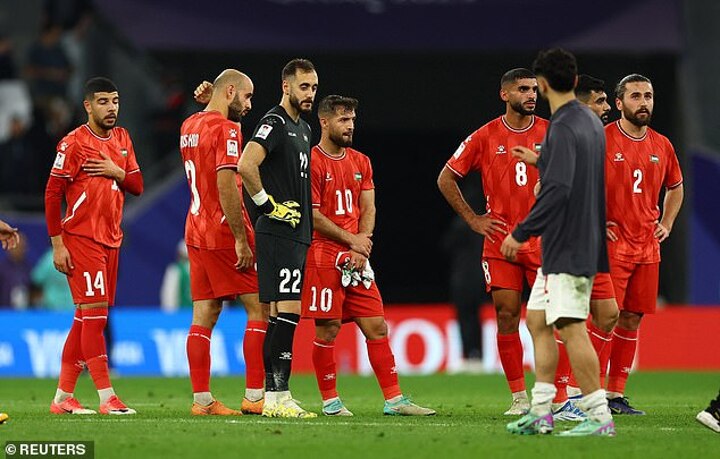
Winning is paramount in sport, always has been. As the band Queen warn: ‘No time for losers’. The pain of losing is raw. It hurts. It lingers.
Yet for Palestine, the human losses in recent months made fielding a team here at the Education City Stadium a win in itself.
It didn’t matter that they had not won in eight previous fixtures, their last victory a 2-1 triumph over Bahrain in March last year.
It was that this team were able to yesterday play while bombs continue to bombard loved ones in Gaza since Hamas’ horrific October 7 attack on Israel.
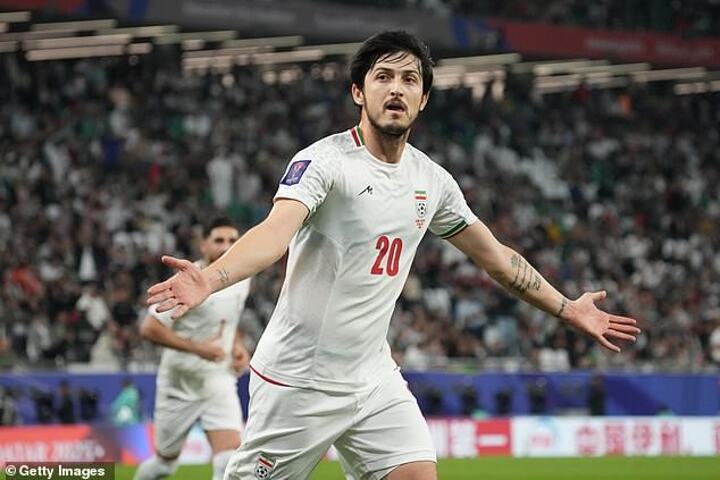
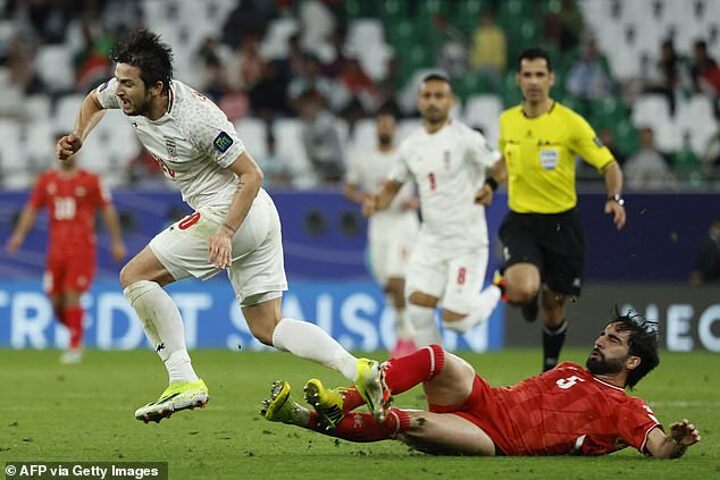
Facing Iran, who are ranked No21 in the world, only behind Japan in this tournament, the task ahead was always going to be steep. Conceding two goals in 15 minutes said as much.
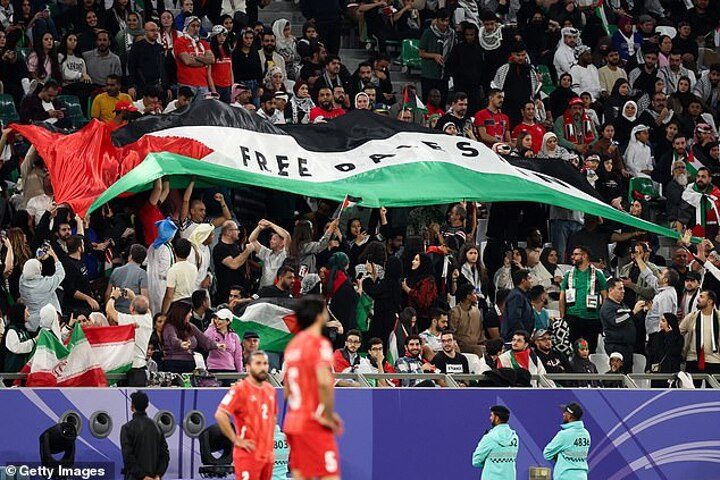
In the stands, the many supporters donning keffiyehs around their necks — a black and white chequered piece of cloth — could not care a jot. And rightly so, as the green, red, black and white flags waved and waved, a stall on the stadium concourse giving them out for free.
You see, this was their 90 minutes of escapism. Initially, it felt rather abnormal turning to my left and right to witness flags being raised and claps aplenty whilst goals were being leaked regularly.
But then again, the wider circumstance was different from a typical match.
The news of death around these parts is no surprise, as reflected when striker Mahmoud Wadi slowly ambled over to Mail Sport before their training session on Saturday after receiving a phone call from back home.
‘My cousin was killed today,’ he told Mail Sport. ‘Thirty minutes ago I heard this.
‘It is difficult to say how I feel now. Three days ago, I couldn’t contact my family but (today) I saw by coincidence a video on Instagram of a car going to a hospital.
‘I saw from far away someone in a red jacket — this is my jacket. So I guessed this was (him).
‘We tried to contact anyone there, but we could not. After an hour some of my neighbours there contacted my brother here and told him what happened to my cousin.
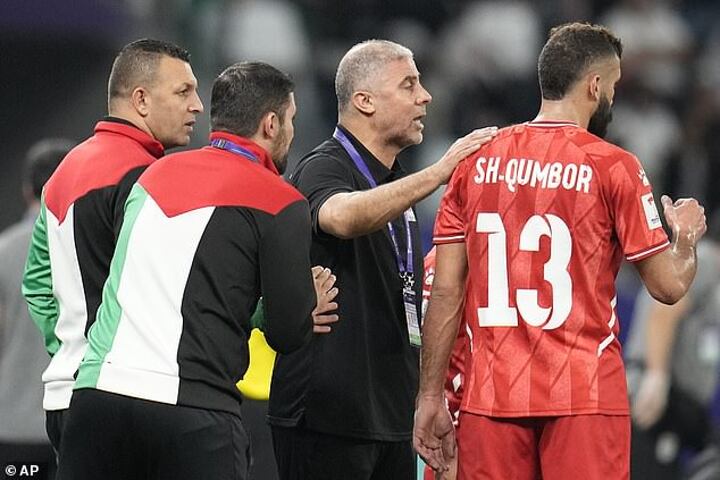
‘We need to spread awareness so people know they are still with us. This cup today is very important, to hold our flag and symbols.’
Manager Makram Daboub said his squad had ‘psychological issues’ and ‘were suffering’ because of the ongoing war.
How they have the mental fortitude to compete in an international competition, who knows. But when the lives of family and friends are in danger, a mere football match is a pastime, a distraction somewhat.
Fan Hany Atat, 28, whose grandparents fled Palestine during the 1948 war, said: ‘Sure, we are proud of them (the players).
‘Sadly we’re not here to cheer for football, we are here just to cheer for our national team to show the world that Palestine is there.
‘The feeling of being a Palestinian, no one can change that. Sport is a channel for us to deliver that message of us existing.’
Two of the squad, Mohammed Saleh and Wadi, were born in Gaza. Some of the players have family stuck there. A number have had former club team-mates die since the October 7 attack.
They are in this AFC Asian Cup for reasons far wider than football, a message of hope to their compatriots at a time of need.
Daboub said: ‘Everyone is focused on the news and what is happening but even with that, inside every one of us, from the technical staff to the players, there is a message that we need to deliver to the whole world.
‘We have a big responsibility that we are the ambassadors for Palestinian soccer, and ambassadors for Palestine. Through the matches, our presence and what we will deliver in this tournament should be a message for the whole world that Palestine exists.’
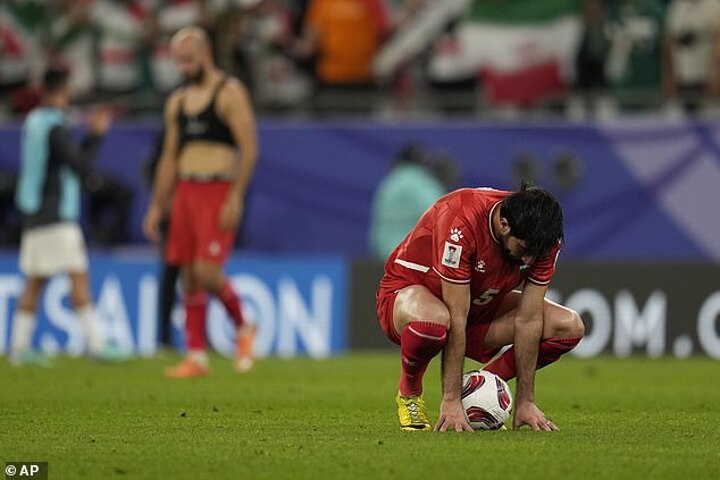
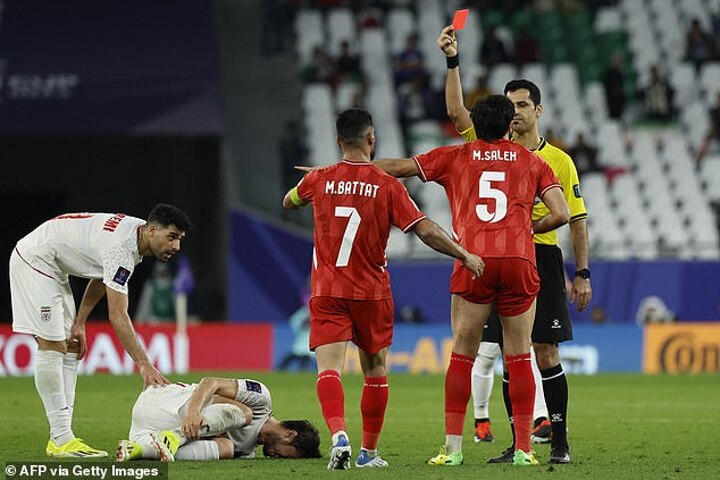
Sport is often, forcibly, eulogised as a uniting force. Brings everyone together and all that. Though in this instance, it truly is. Just look at the Palestine squad.
Ataa Jaber captained Israel’s Under-21s. He switched to representing Palestine in June 2023. Amid Mahajna plays for Israeli side Hapoel Umm al-Fahm. He has solely featured in Israeli leagues all the way since the 2016-17 season.
Such a message spills into this tournament itself.
Earlier in the day, Takehiro Tomiyasu, Arsenal’s full back whose estimated transfer value outweighs that of Palestine’s entire 26-man squad, watched his Japan team beat Vietnam 4-2.
Mahmoud Abu Warda, who plays for Markaz Balata, a team based in a West Bank refugee camp, was facing Iran hours later at a stadium which hosted Croatia knocking Brazil out of the 2022 World Cup quarter-finals. Wildly different circumstances, brought together by sport.
The attacks on Gaza have made any progression in this competition a near impossible task for Palestine, emotional trauma aside.
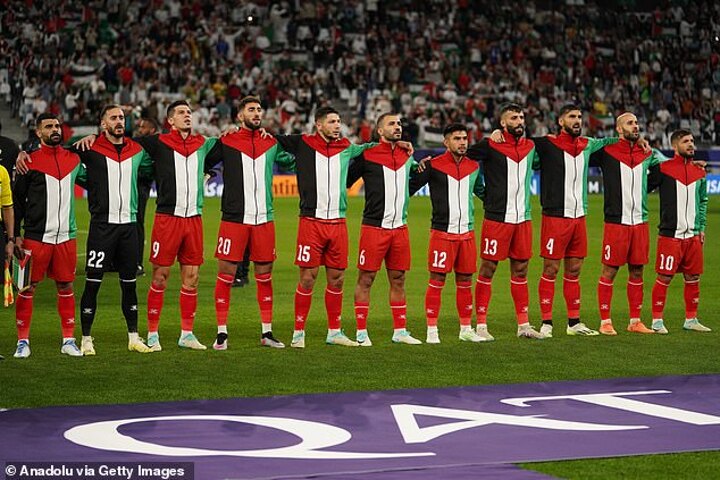
Twelve of their squad plays in the West Bank Premier League, a league that has been suspended since October 7. Just two qualifiers in November and two friendlies this month have been available to them in that time.
It was a stark contrast indeed against opposition who were unbeaten in 13 matches.
Though tension surrounded them, too, for different reasons with Iran fiercely politically divided.
The Iran football team were allegedly threatened with reprisals by government officials over a refusal to sing the national anthem prior to their 2-0 win over Wales in the 2022 World Cup, in solidarity with fans over the death of 22-year-old Mahsa Amini in police custody.
And just last week, footballer Amir Reza Nasr Azadani was reportedly sentenced to 16 years in prison for taking part in protests.
On Sunday, it was goals from Karim Ansarifard and Shojae Khalilzadeh which put Iran in front. They scored another two, but Palestine’s sole goal on the stroke of half-time raised the loudest cheer of the night.
Tamer Sayem bundled the ball in off a deep free-kick. It was their only goal, yet something supporters could take home.
Whatever is to transpire for Palestine in this tournament, scorelines aside, they have won in many ways.