


Pierre-Emerick Aubameyang departed London in February under a cloud.
After being stripped of the Arsenal captaincy for a disciplinary breach, one of the club's most potent finishers had his contract terminated before making the move to Barcelona under Xavi's revolution.
Aubameyang arrived at Barcelona with a simple remit for a side whose attacking potency was on a downward spiral — score goals.
Just seven months on from his secondment in Catalonia, Aubameyang returns to London wearing Chelsea blue, with the similar task of carrying the goalscoring burden for a side struggling to put the ball in the back of the net.
There is little doubt about his quality, but just how good a fit is he for Thomas Tuchel's side?
Chelsea's need for a clinical finisher has been glaringly obvious in the opening weeks of the season, with just six goals from their opening five games.
The term “clinical finisher” is used carefully here — not necessarily a central striker, not necessarily a fixed No 9, but the need for a tactically versatile goalscorer who is able to operate within Tuchel's fluid front line.
Raheem Sterling has assimilated since his arrival in the summer, working well with Kai Havertz and Mason Mount in particular. The trio overlap in terms of their skillset in and out of possession, with good positional interchange giving them freedom to attack.
Unfortunately for Tuchel, they also overlap in their lack of ruthless edge in front of goal. The story of Chelsea's season so far has been their ability to get into threatening positions, create good opportunities, but fail to convert.
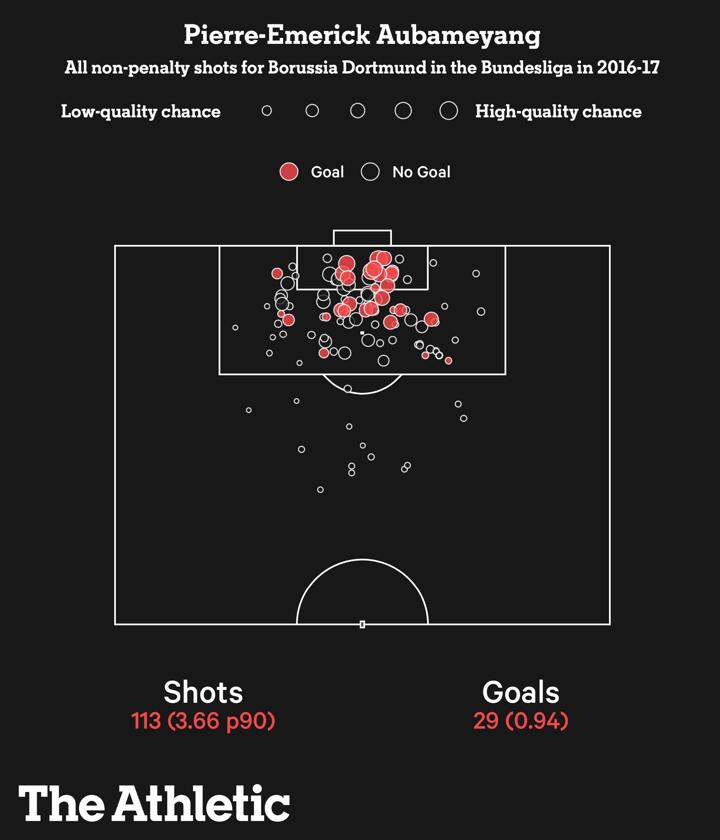
Tuchel will no doubt remember the good times he shared with Aubameyang, where the Gabon international enjoyed the most prolific season of his career at Borussia Dortmund, scoring 31 goals (29 non-penalty goals) in the Bundesliga in 2016-17 — ostensibly spearheading the attack as a central striker.
Six seasons on, Tuchel is less likely to get the same return from a 33-year-old Aubameyang in front of goal.
Aubameyang largely rotated between a central striker and a left-wing role at Arsenal, but his first spell in the Premier League actually produced an overall decline in his chance quality and goalscoring output per 90 minutes.

Aubameyang did score 11 goals in 17 La Liga appearances for Barcelona in the second half of last season — a small sample of games, but a rate of 0.91 goals per 90 is form on a similar level to what he achieved under Tuchel's management at Dortmund.
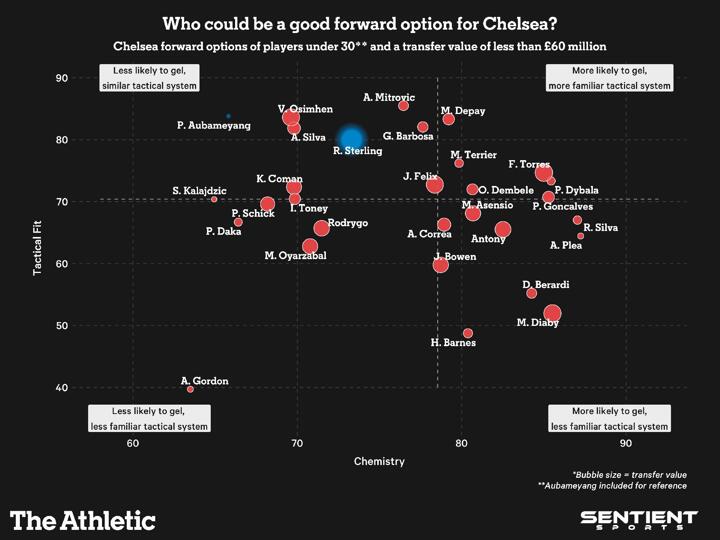
Realistically, the question is less about Aubameyang's ability to score, but how he would fit within Tuchel's Chelsea squad. Using data from Sentient Sports — as previously outlined by The Athletic — we see that Aubameyang might require a little time to adapt to his team-mates at Stamford Bridge.
Using advanced artificial intelligence, this model predicts how well players would perform if a transfer was made, using soft features such as age and language, as well as individual playing styles.
The model predicts Aubameyang would create strong partnerships with Mount, Conor Gallagher and Sterling, but he would not link well with Havertz, Ruben Loftus-Cheek or Armando Broja. This is particularly interesting when considering that it may well be Havertz who would make way for Aubameyang in the starting XI, with the Germany international failing to find the back of the net this season.
Tactically, Chelsea are less cross-heavy than last season's Barcelona, but with Aubameyang in the side, you might expect that to change. Notably, Aubameyang has very rarely played in a 3-4-2-1 system so would need to adapt to the new formation. However, he could give Tuchel the opportunity to play with two in attack as an alternative to the dynamic front three.
Aubameyang would also provide Tuchel's side with the threat of runs in behind the defence, whether from outside to inside if he's starting wider in a front two, or from inside to outside to support Chelsea's wing-play if he's starting centrally in a front three.
It's just a small niggle, but is there an element of deja vu here for Chelsea fans? This time last season, questions were posed about Romelu Lukaku's ability to operate in more congested areas for Chelsea, compared with his more expansive role alongside Lautaro Martinez in a 3-5-2 at Inter Milan.
The same question could be asked of Aubameyang, who remains devastating in open space but would be operating against deeper-block oppositions for Chelsea in the Premier League, needing to find tighter pockets of space to get a shot away.
Aubameyang operated more as a central striker in Xavi's 4-3-3 during his time in Spain, often flanked by the pace and trickery of Ferran Torres and Ousmane Dembele. Looking at the locations from which he scored his 11 non-penalty goals, you can see how much he profited from central areas around the six-yard box, often finishing first time from well-worked passes and crosses.
His non-penalty 0.19 xG per shot — which measures the average chance quality of a given shot — was the fifth-highest in La Liga last season among those with 900-plus minutes.

Wesley Fofana's arrival in defence will free Reece James to play in his favoured advanced right-wing back role. James is crucial to Tuchel's attack and his delivery from wide will be something Aubameyang could profit from. The quality of his delivery was on show last weekend against Leicester City, when he provided a wicked ball across the six-yard box for Sterling to finish into an empty net towards the back post.
Sterling is not a centre-forward by trade, but has honed his ability to arrive late into the box. Greater width and more frequent delivery from wide is something Chelsea need to to get back to this season — knowing that the likes of Sterling and Aubameyang will be darting into those areas.
The Gabon striker thrived on back-post crosses at Borussia Dortmund and Arsenal, positioning himself to attack crosses played from the other side of the penalty box.
That aspect of his game could heavily benefit Chelsea when you consider their strength in wide areas from both sides. As you can see below, since the start of last season they have been most potent from the right-hand side to the left back post.

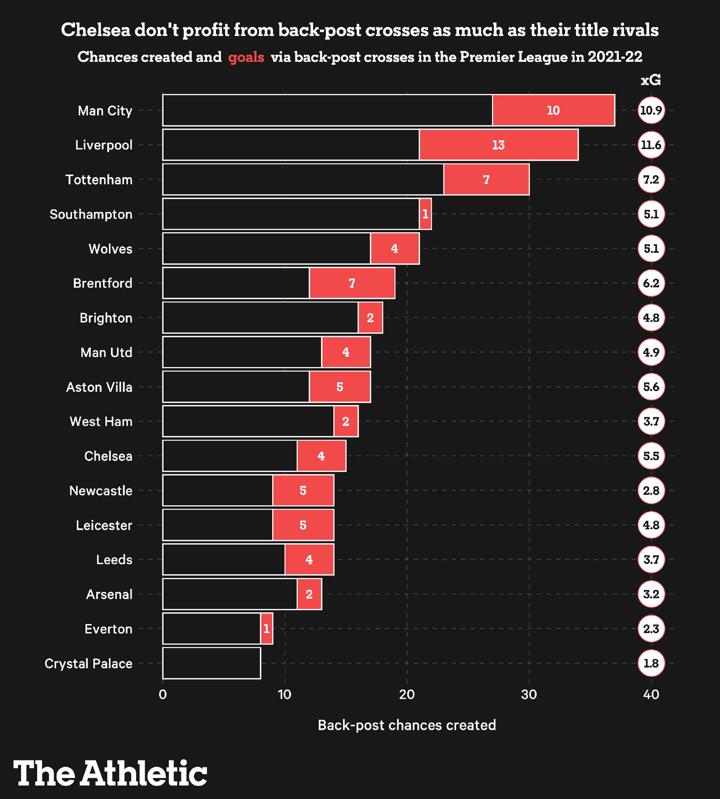
Across the whole league, Chelsea don't attack that space as much as they should, ranking 11th-highest for back-post chances created since the start of last season.
Compared with title rivals Manchester City and Liverpool — who lead the league for back-post chances created — Tuchel's men should look to create more chances like this to make the most of the runs of Sterling and Aubameyang.
The link-up between Sterling and Aubameyang in particular will be interesting. From his time at Arsenal, we know Aubameyang is capable of operating on the left side of the attack and even likes to drift into those areas when playing as a central striker — areas that Sterling has frequently occupied for his new side.

Assimilating within those positional interchanges will be key for Aubameyang when operating with his new team-mates. On a good day, the rotations in Chelsea's attack could be devastating. On a bad day, their forward line could be guilty of getting on top of each other by picking up the same positions.
What keeps Sterling, Havertz and Mount in the team is their relentlessness off the ball as well as on it. While a 33-year-old Aubameyang might not have as much in the tank as he used to, he did show a notable improvement in his defensive responsibilities at Arsenal, often setting the tone for his team's pressing under Mikel Arteta.
This continued at Barcelona, where his 10.3 pressures in the attacking third per 90 topped the list for his side in La Liga last season.
Of course, Aubameyang will be judged on his goalscoring and he arrives at Stamford Bridge with the same task of sharpening up the attacking threat for a side that are struggling to convert their dominance into goals.
For Aubameyang, it's London 2.0 and a second chance in the Premier League.
The cloud has lifted.