


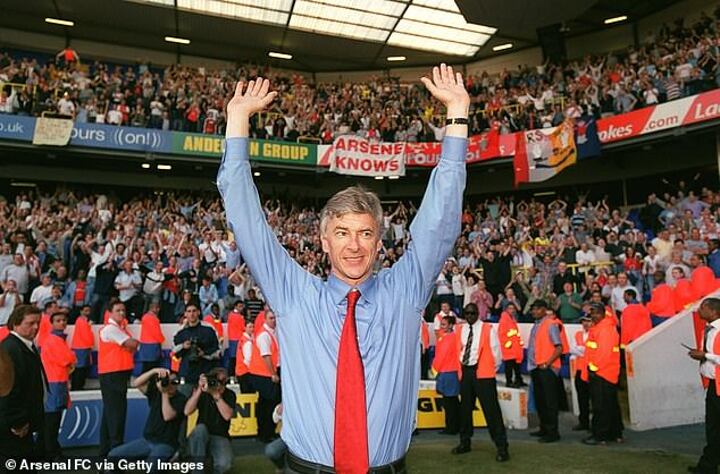
When the time came for Arsene Wenger to write his final programme notes as Arsenal manager he sprinkled in advice for whoever would follow him into the job.
'Move the club forward with your own ideas,' wrote Wenger before his final home game, against Burnley in May 2018. 'Don't be struck too much by what happened before, just do what you think is right for the club. Think and act for the club like you own it. Prepare to have the strength to fight every day to do the best possible for Arsenal.'
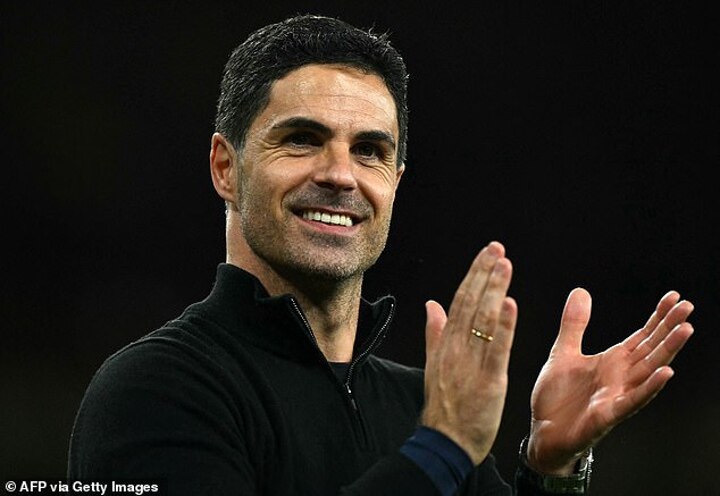
It is as if Mikel Arteta has had the page pinned to his bathroom mirror for the last six and a half years.
Stylistically, his champions have little in common with Wenger's flamboyant creations, teams that made Arsenal such an irresistible attraction as the Premier League's tentacles wrapped around the world. He has refused to be chained to romantic notions of the past, but his desire to do the best for the club is not in doubt. He has fought tooth and nail to drive Arsenal on because what mattered most was to plant their flag on the summit of English football.
Far more important than weaving attractive passing patterns in homage to the prime Wenger years. They tried it that way many times and found it no longer delivered the big prizes for Arsenal.
Football changed. For Wenger, it was like art. Unfortunately for everyone, the scientists and the accountants have taken over. It is a different game. Few if any would claim it is more entertaining, and yet it is perhaps more competitive than ever.
Arteta knew Wenger. He knew Arsenal. He knew it was time to remind the world they still had what it takes to win the biggest prizes. Something long overdue. Not since they were first crowned English champions in 1931 has the wait to reclaim the title been so interminably long.
Twenty-two years. At times, desperate years. Riddled with angst and infighting. Often emotional. At times, maddeningly frustrating. Boring, perhaps. Finishing five times as runners up and never sinking below eighth. A bellyful of sausages and not enough of the caviar to which they had become accustomed.
At last, the waiting is over. Arsenal are champions for the 14th time and Arteta can take his place alongside Herbert Chapman, George Allison, Tom Whittaker, Bertie Mee, George Graham and Wenger as architects of those triumphs.
Different titles won in different eras through 95 years. People are entitled to say it has not been a classic and Arteta is entitled to say he does not care. He trusted his own ideas. He summoned the strength, did what he thought was right and fought for Arsenal. Nobody can ever take that from him.
Wenger was not involved in the selection of his successor. He liked the idea of his former captain Arteta returning after two years as Pep Guardiola's assistant at Manchester City but left it to the triumvirate of chief executive Ivan Gazidis, head of football Raul Sanllehi and head of recruitment Sven Mislintat.
'I deliberately kept out of the way,' Wenger wrote in his autobiography, My Life in Red and White, published in 2020. 'I had to keep my head down, even though it seemed to me that the people making the decisions for the club knew it less well than I did.'
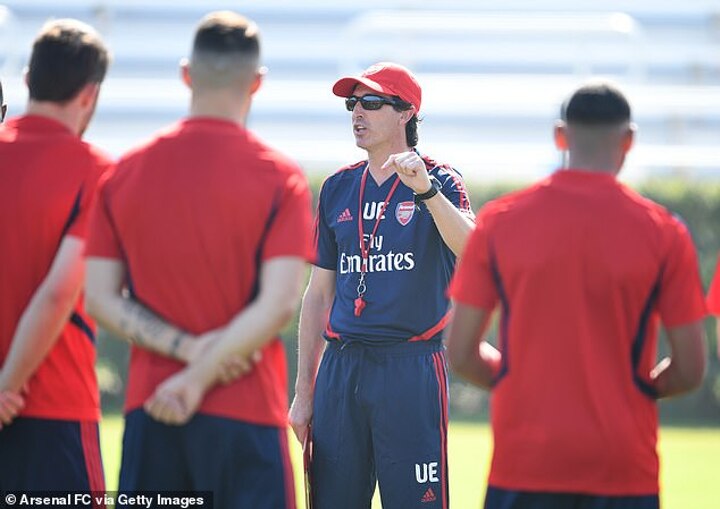
Arteta was interviewed but ruled to be too young and inexperienced. Unai Emery, championed by Sanllehi, got the job instead. Emery's success at Aston Villa proves his coaching quality although he has been allowed to bring in people he trusted and mould the club as he wished at Villa Park.
One key figure has been Damian Vidagany, a former journalist turned media officer at Valencia turned personal PR guru for Emery at Villarreal and now employed as Villa's director of football operations. Emery had no such personal support network at Arsenal, where he stepped into a power struggle which had started before Wenger's exit and accelerated upon his departure, the end of an era after 22 years in charge.
There was a whirl of change and a post-Wenger power grab. Before 2018 was over Gazidis had gone too, and Stan Kroenke had bought Alisher Usmanov's rival stake and completed his full takeover. Mislintat followed by February 2019. Edu arrived as technical director in May 2019. Sanllehi survived until August 2020.
Emery came and went within 18 months. He reached the 2019 Europa League final where Arsenal lost to Chelsea at the end of his first full season and finished in fifth, a point behind Tottenham.
In his one summer window, they spent £130m with more than half of it squandered on Nicolas Pepe from Lille. But they also signed teenagers William Saliba (£27m) and Gabriel Martinelli (£6m), shrewd business in hindsight and both integral to this title seven years on.
Emery had little control over a muddled recruitment strategy. Nor did he ever really connect with the fanbase with no Vidagany figure to guide him through a media strategy. His private messages were apparently no less confused than his public ones.
Arsenal had not won in seven games when he was sacked in November 2019, the day after a home defeat to Eintracht Frankfurt in the Europa League, and were eighth in the Premier League, behind Wolverhampton Wanderers, Sheffield United and Burnley.
'We know and I know that we need to connect with our supporters,' said Emery after fans at the Emirates had unleased their anger during what proved to be his last Premier League game, a 2-2 draw at home against Southampton.
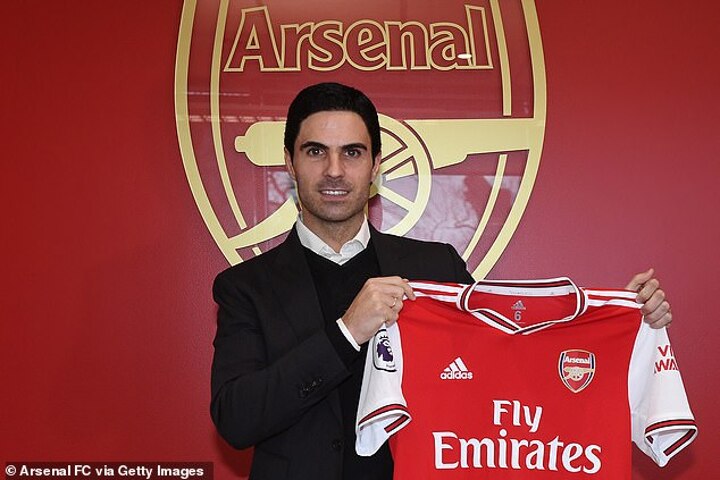
This time, the job was Arteta's. The risk of his rookie status offset by an Arsenal past, leadership credentials as a strong and thoughtful captain and the seal of approval from Wenger. Beyond this, there were three years hoovering up the silverware beside Guardiola at Manchester City.
Arteta arrived in dynamic fashion. Admitting he thought the club had lost its way, he vowed to 'build a culture'. He made it one of his priorities to reconnect and unite a tortured fanbase.
First, he had to navigate the Covid pandemic but Arteta's instinct drove ideas such as the introduction of the Ashburton Army singing section into the Clock End and the North London Forever anthem which have improved atmosphere inside the Emirates Stadium.
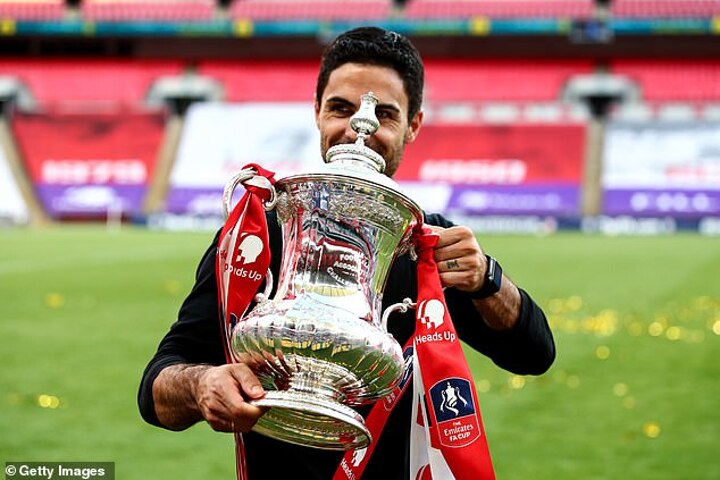
The only major trophy of his first six years however was an FA Cup won in a deserted Wembley Stadium. Perhaps the empty stands were a blessing in disguise as his project suffered early missteps. In his first full season, there were home defeats by Leicester, Wolves and Burnley in the Premier League. Combined with defeats at Tottenham and Everton in December, Arsenal were languishing in 15th at Christmas and sore from a 4-1 thrashing by Manchester City in the League Cup.
Judging by the online criticism, the silence in the stands might have been better than the alternative. The board peddled messages of faith in their man, although the heat was on Arteta going into a Boxing Day fixture against Chelsea, when a 3-1 win sparked a mini revival.
Arsenal finished in eighth for the second year in a row, digesting the prospect of no European football for first time since before Wenger. Still, there were key positive factors from this time, such as Bukayo Saka, Emile Smith Rowe and Martinelli breaking through, and Gabriel Magalhaes arriving from Lille as Arteta weeded out others.
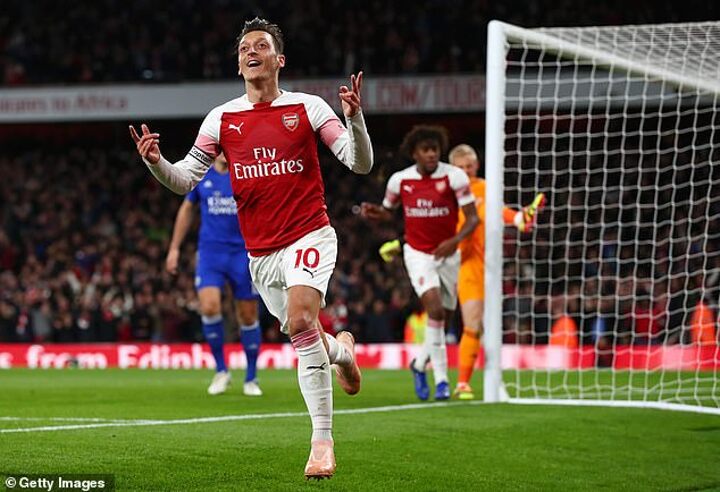
Henrik Mkhitaryan's contract was cancelled by mutual consent four months before the purge of January 2021. Mesut Ozil, having been left out of the Premier League and Champions League squads, was paid up the remainder of his contract and left for Fenerbahce after seven-and-a-half years in North London. Once a talisman of fresh intent as Arsenal were freed from the shackles of Emirates debt repayments, Ozil had become a symbol of largesse on his new deal signed in 2018 worth £350,000 a week. He had not played for 10 months.
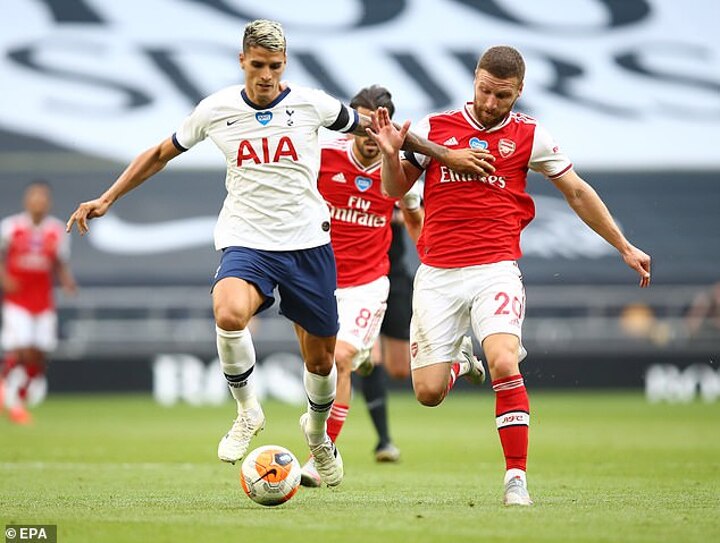
Shkodran Mustafi and Sokratis Papastathopoulos were sold. Sead Kolasinac joined Schalke on loan and would not return. It was the first public flash of Arteta's blade and a recurring theme of ruthlessness. Anyone not on board with this plan should get off the boat. And he set about moulding some of the young minds left behind.
Backing the manager in modern football is about more than delivering new signings. Increasingly, it involves taking a stance and a financial hit to clear out misfits. This was a show of faith by an Arsenal board unwilling to hit eject again so soon after Emery and tip the club into a cycle of instability.
For one so inexperienced, Arteta has proved an astute politician, able to detect shifting influences above him as executives changed and aligning himself with the right people, be that Edu, vice chair Tim Lewis, Edu's replacement Andrea Berta or Josh Kroenke after his emergence from the shadow of his father Stan.
His title was upgraded from head coach to manager in an internal restructure within a year of his arrival. He rode the bumps such as starting 2021-22 with three defeats, nine conceded and none scored.
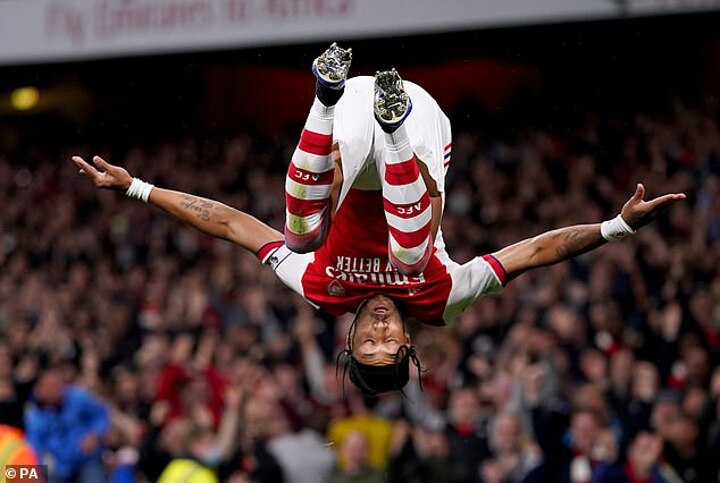
There was another power play, arguably greater and more significant when he tired of Pierre-Emerick Aubameyang's indiscipline and unreliability. Not only was he the captain and biggest goal threat, Aubameyang was popular and charismatic figure in the dressing room and had 18 months remaining on a contract worth £350,000 a week. Arteta wanted him out, took him on and he got his way. Statement made. There was no longer any doubt who was in charge.
Having seen at close quarters the standards of Guardiola's City, Arteta understood exactly what was required to catch them even in an off year at the Etihad and in a world where sporting greatness was increasingly decided by detail, he was prepared to take no risks. To hammer the point home, he signed Gabriel Jesus and Oleksandr Zinchenko to inject more of City's excellence into the dressing room.
Other things dropped into place. The show of patience with Saliba, who spent three years on loan developing in France, was rewarded. By the time he landed in London he was complete and a perfect foil for Gabriel.
Arsenal finally launched a title bid and came second in 2023, their best finish since 2016 when they ghosted between Leicester and Spurs to finish as runners-up despite never having been in the race.
Then they spent a record transfer fee £100m on Declan Rice after public murmurings from Arteta about his disappointment at the idea of not being able to take the club any further forward. The 44-year-old Basque can appear uptight and charmless but used his personal touch and inner fire to persuade Rice to resist City and Bayern Munich. It also inspired the capture of Mikel Merino and Martin Zubimendi from Real Sociedad.
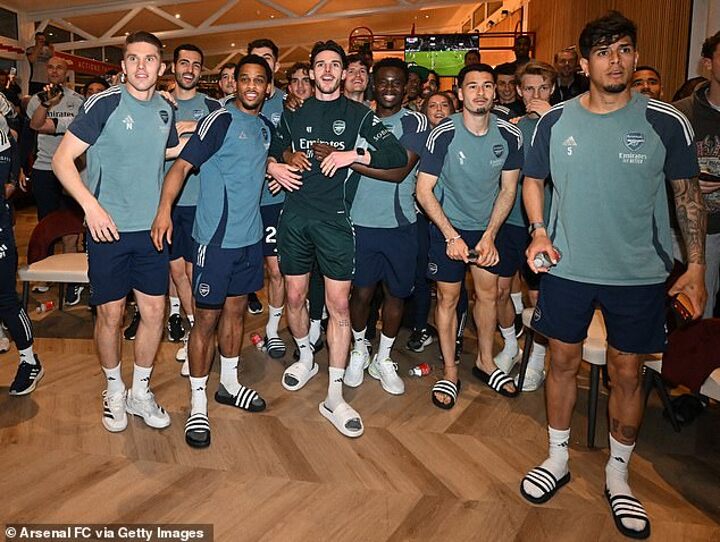
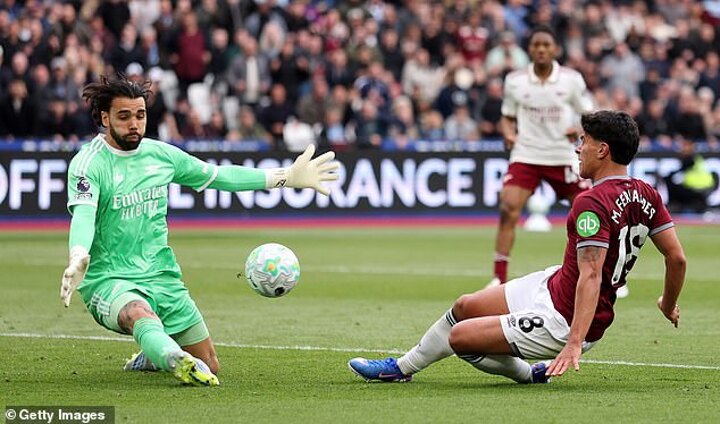
The squad packed on the muscle as second again to City was follow by second to Liverpool.
Arteta had signed David Raya when he could and because he could and upgraded on Aaron Ramsdale who had to the untrained eye done nothing much wrong. And he signed Eberechi Eze when he could because he could and then reined in the flair to produce an attritional machine based on the solidity of the centre halves, Rice and Raya, and leaning into the marginal gains of set plays.
This is Arteta's Arsenal. Certainly, it is more pragmatic than anything Wenger or Guardiola would tolerate and yet he restored pride. Certainly, he has fought every inch of the way for the club he represents, irritating opponents and neutrals alike with his incessant touchline antics, micromanaging his team, pressurising the officials.
This is Arteta's title. Winners once again. The waiting is over.