


According to The Athletic, Manchester United is replacing the pitch at Old Trafford for the first time in 14 years.
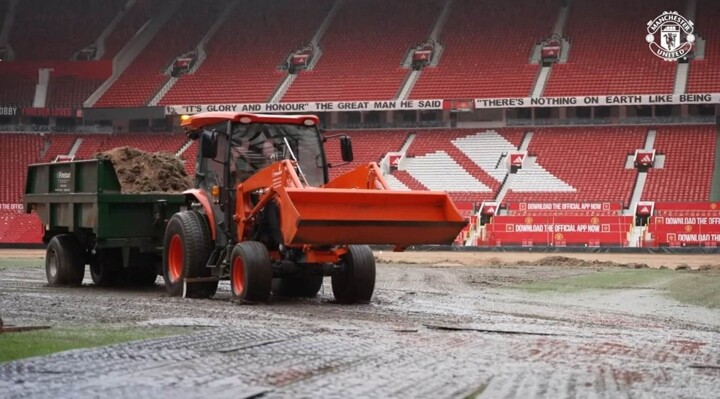
Old Trafford looks quite different at the moment. Manchester United is installing a completely new pitch, the first time the club has undertaken such a project in 14 years. After the season ended, the club held a series of fan-involving matches, and construction then began. Now, heavy machinery operates where players usually run, and what was once green grass has turned brown, resembling pitches from the 1970s and 80s during winter.
The Athletic interviewed Manchester United Chief Operating Officer Gary Neville. Neville was born in Salford and is a Manchester United fan, having watched matches from the terraced standing section in front of the Stretford End as a child. He has worked at the club since 2005.
Neville stated: "We think it's time to replace the pitch now because if we were to move from the current stadium, this current pitch wouldn't last until then."
Neville explained: "Imagine a cross-section of the pitch: the very top is what you can see—the green grass layer, which is the plant itself. Below that is the upper root zone, and further down is the lower root zone. This area is about 150 to 170 millimeters deep and is stitched with plastic fibers. Below that is the underfloor heating system, and beneath that is the drainage layer."
"There are a total of four layers here, with an overall thickness of about 500 millimeters. What we are doing this time is removing the grass layer, the upper root zone, and the lower root zone, so we will dig all the way down to the underfloor heating system."
"We are doing this because, over time, the top layers become compacted due to various uses. Once the soil becomes compacted, water infiltration and drainage worsen. This is exactly what we are concerned about. Last season against Chelsea, there was heavy rain during the match, with 25 millimeters of rainfall, which is a very significant amount. The pitch was nearly waterlogged in that game. But thanks to maintenance by the grounds team over the years, the pitch didn't genuinely get waterlogged, and the ball could still roll. We also won the match. This pitch hasn't caused any matches to be postponed, but we must look to the future. Our concern is that if we don't replace the pitch and we encounter the same level of rainfall five years from now, the pitch might become waterlogged."
Neville said: "The project started on June 11th. So far, we have removed about 2,000 tons of material, digging all the way down to the underfloor heating system. Now we are re-laying the root zone and leveling it. We will sow the seeds before the end of this month, and then monitor the grass growth. We will water, nurture, and perform meticulous maintenance such as mowing to get it ready for the start of the new season."
"We lift the grass layer, remove all the soil and sand, and recycle it. We separate the plastic from the soil and sand. Other materials will also be recycled for landscaping and other construction projects."
"Pitch technology differs from the 1960s, 70s, and 80s. Back then, when we watched matches, the pitch sometimes looked like a mud patch. Later, we evolved from native soil pitches to what are called fiber-sand pitches. Native soil pitches are basically the kind of grass you find in local parks; fiber-sand pitches mix sand and other fibers beneath the grass layer to improve drainage."
"Then technology brought hybrid pitches: in addition to real grass, which is the plant itself, about 3% of the entire pitch is stitched plastic fibers. This makes the pitch structure more stable and also helps players get stable support when moving. The hybrid pitch we used previously was laid about 14 years ago. They usually last about 10 years, but we extended the life of this pitch to 14 years, thanks to Tony Sinclair. Tony is our award-winning Head Groundsman, who has worked at the club for 37 years and is an outstanding contributor, as is his team."
Neville stated: "We want to ensure that both the training ground and Old Trafford have consistent playing surfaces. We monitor pitch quality, and the key is how you maintain it—for example, controlling nematodes, ensuring sufficient light and water, using sharp blades for mowing, and avoiding stressing the grass. We also need to pay attention to grass length and monitor moisture content. We can measure infiltration rates, and we can also measure pitch hardness."
When talking about nematodes, Neville explained: "It's a parasite that feeds on roots and damages plants. One way to treat it is to spray liquid garlic on the grass. When we treat the pitch, you can smell garlic."
Neville also said: "We are removing the pitch and then putting it back in the same place. However, there will be other changes. If you look at the pitch from the South Stand, you'll see that the natural grass only extends about 50 millimeters beyond the touchline, and then further out is artificial turf, and then down to the sloped area with bricks."
"For player safety, we will replace the upper part of that artificial turf with natural grass. Imagine if you are running along the touchline and the studs of one foot land on artificial turf—it's a different surface, and your body might suffer an impact. We will expand the grass area to eliminate this risk. There is also a drop there, and we will install padding in some areas to protect players, so player safety is also part of this project."
When asked if the new pitch would feel different, Neville replied: "If we do our job well, it won't. We are completely replicating the original pitch, and the original pitch was still very, very good. The Premier League holds a pitch assessment every year, and Tony has performed exceptionally well over the years, winning the Pitch of the Year award multiple times. Although this pitch has been in use for 14 years, it was still recognized this year, ranking in the top five. The only clear improvement we hope to make and problem we hope to eliminate is the issue of waterlogging, so we can ensure proper drainage."
Regarding the number of people involved in the project, Neville said: "About 50 people are directly involved. Heavy machinery will enter through the access point at the Stretford End. They will strip the pitch, remove the material, bring new material in, and re-sow. The sowing amount is 400 kilograms, 55 grams per square meter. After that comes stitching, nurturing, mowing, and line marking. We will use laser scanning to record the elevation. When laying the new pitch, we will also use laser scanning again to ensure the elevation is completely correct. Completing this project is a major undertaking, but it's the right thing to do. We all want it to be a success."
Neville concluded: "I'm at Carrington today, but I'll be at Old Trafford two or three days a week, and I'll marvel at that pitch. You can see the work Tony and his team put into it, the care they invest. I look at it, and then I go home on the weekend and stand on my own lawn, and I think: 'I wish I had a pitch like Old Trafford.'"
AF's PC site is now live! Browse full news, comments, match details and stats on your computer. Visit: www.allfootballapp.com