


Manchester United find themselves in a familiar scenario as they weigh up appointing Michael Carrick as head coach long-term, with eerie similarities to the route Ole Gunnar Solskjaer took to getting the job full-time.
Results have been remarkable since Carrick replaced Ruben Amorim in mid January but doubts around his suitability linger, some of which are borne out of those comparisons with Solskjaer, who also steadied the ship after a turbulent period under a Portuguese coach.
Carrick has dismissed the Solskjaer parallels as "irrelevant" – but that will do little to quash a narrative that has already taken hold. But is it a fair one?
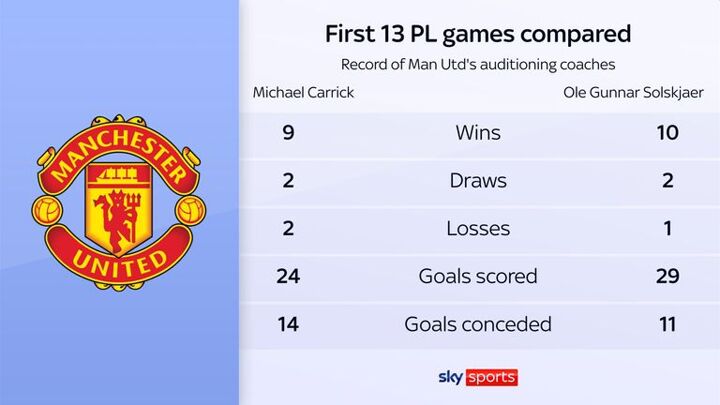
Solskjaer took charge of 13 Premier League games before he earned himself the permanent job in 2019 after initially arriving from Molde as caretaker. Carrick has now been in place for the same number of games - so we have taken a look to see how their stints stack up.
Who had better results?
Solskjaer has the edge on Carrick in terms of results, picking up 32 points from a possible 39, three more than his former assistant after 13 league games.
His side also scored 29 goals, five more than the current United team have managed under Carrick, while conceding three less goals.
However, that run included games against all three relegated teams and only four came against teams that finished in the top half of the Premier League in 2018/19.
Carrick's side have played against seven teams that start the weekend in 10th or above since he replaced Amorim and only one currently in the relegation zone.
Solskjaer's biggest result was a 1-0 away win at Mauricio Pochettino's Tottenham, who finished the season in fourth. Marcus Rashford's precision finish after a ball over the top from Paul Pogba was the difference at Wembley thanks to David De Gea's heroics.
In his first two games alone, Carrick is ahead of Solskjaer on big-game credentials. United produced two magnificent performances to beat the best two teams in England, Man City and Arsenal, in back-to-back games.
Carrick's side also beat Aston Villa, on course to seal Champions League qualification themselves, to strengthen their grip on third.
What about the fixture schedule?
Carrick's argument when he dismissed the Solskjaer comparisons was that every coach exists within their own unique set of circumstances – and he is right.
Solskjaer had to contend with both the Champions League and FA Cup while Carrick has enjoyed the luxury of midweeks off in between league games. At one point United had a 24-day break between games this season.
Including those competitions, Solskjaer had some big wins of his own, triumphing over Chelsea at Stamford Bridge in the FA Cup and, of course, that famous Champions League last-16 comeback win against Paris Saint-Germain.
Encompassing every competition, Solskjaer took charge of 19 matches over 86 days compared to Carrick's 13 over 101 days.
Who had a better team?
A bad workman blames his tools, but it is important to consider which players each manager had available to them when auditioning for the United job.
So, we have selected both Carrick and Solskjaer's preferred XIs based on the teams they picked for the biggest games over the 13-match stretch we are looking at to let you decide.
Let us know which team you think is better using the poll below.
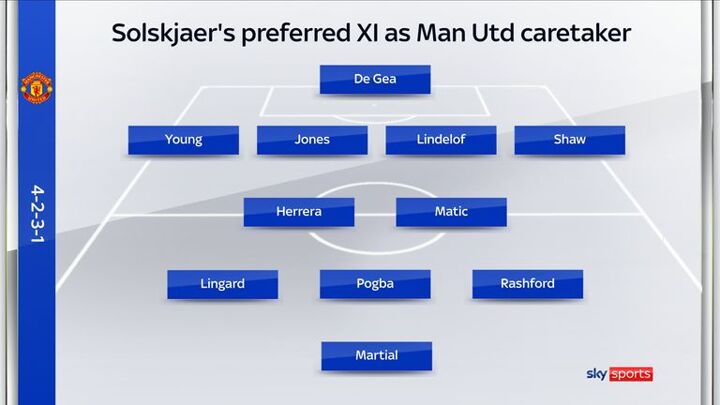
Other notable players to consider that were available to Solskjaer: Eric Bailly, Chris Smalling, Romelu Lukaku, Alexis Sanchez, Juan Mata, Fred, Scott McTominay.
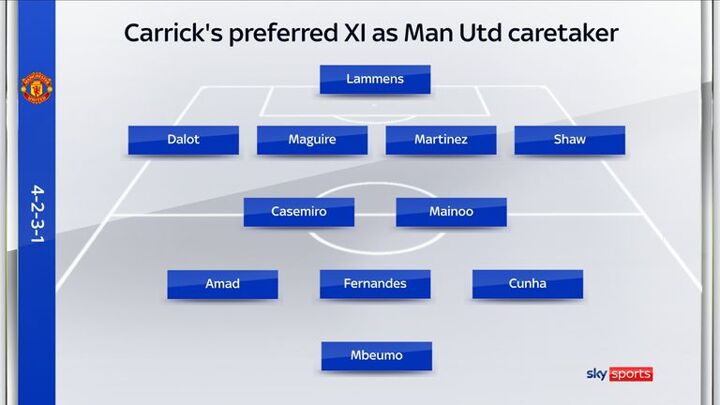
Other notable players to consider that have been available to Carrick: Noussair Mazraoui, Patrick Dorgu, Mason Mount, Leny Yoro, Ayden Heaven, Mason Mount, Manuel Ugarte. Benjamin Sesko, Joshua Zirkzee.
How do the styles compare?
Solely looking at league table position, Solskjaer has been one of United's best managerial hires post-Sir Alex Ferguson, but his legacy is clouded by criticisms about the style his teams played with.
United often relied on moments from star players, rather than any discernible style of play beyond counter-attacking football, which stopped Solskjaer's teams from taking that step to compete for the biggest trophies.
Like Solskjaer, Carrick's best games have come in games when the opposition are expected to have more possession, giving his team the chance to counter-attack as shown in big wins over City and Arsenal.
This similarity has only added weight to the narrative around Carrick being another repeat of Solskjaer, which is not entirely unlikely because he was, of course, his assistant at Old Trafford.
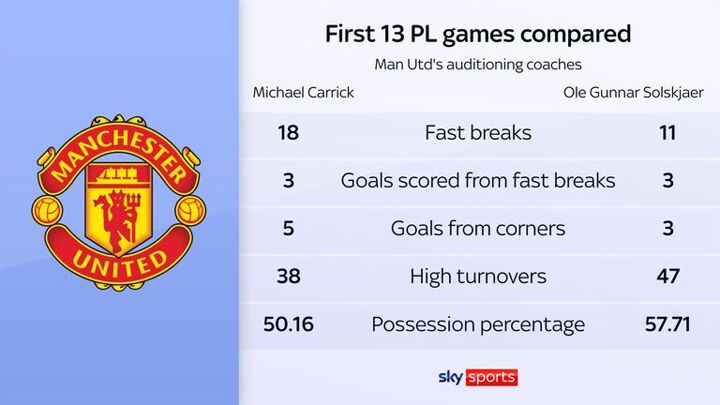
Comparing their first 13 league games in charge, those similarities are clear to see when you dig into the numbers as shown on this radar graphic.
Carrick's side are recording more fast breaks on average, perhaps helped by their tougher schedule, as highlighted above, but the biggest difference is in headed goals.
That should come as no surprise with set pieces so in vogue in the Premier League right now - especially as United are among the most prolific from deadball scenarios behind Arsenal.
What about the context?
Understanding the situation each manager inherited is another key consideration. Although Amorim and Jose Mourinho share a nationality, it is fair to say that they did not share similar relationships with their squads when they left United.
Solskjaer came into a toxic environment left behind by Mourinho, who stayed in the swanky Lowry Hotel for the entirety of his stay. His spat with Paul Pogba had also become public and there were reports of divisions in the camp.
Amorim left in a blaze of fire after essentially calling out director of football Jason Wilcox in a press conference before he was given his marching orders.
Those issues were confined to his relationship with the hierarchy, however, with very little to come out subsequently suggesting that he had lost the dressing room in the same way Mourinho was seen to have done.
United had lost three of Mourinho's last eight games in charge before he was sacked following a miserable 3-1 defeat to Liverpool at Anfield.
Results preceding Amorim's departure were much better than they had been when he arrived, United losing only one of his final eight games in charge and winning three of those.
The issue for Amorim was his inexplicable reversion to a back three when finally playing in a back four had produced improved performances and results.
In some ways, both Carrick and Solskjaer were handed the open goal of making quite simple tweaks to correct the issues of two quite stubborn coaches.
For Solskjaer, it was about injecting positivity into a situation that had been engulfed in Mourinho's negativity, while Carrick simply had to go back to a back four to lift the mood.
Solskjaer could argue that he had to manage bigger egos in a squad that ultimately turned on him, but Carrick has had to endure the comparisons with his former boss as well.
Have your say on which United interim had the better audition after 13 Premier League games...