


For three long minutes, two former World Cup winners stood on the brink of embarrassment.
When Juan Pablo Vargas scored in the 70th minute to give Costa Rica a 2-1 lead against Germany, it was the former side sat in second in Group E, with Japan in first. Both Spain and Germany were on the verge of being on the wrong side of history.
In the 73rd minute, Germany equalised and went on to win 4-2, which still wasn't enough as Spain snuck through in second behind group winners Japan, with Hansi Flick's side suffering a second consecutive group-stage exit in Qatar.
If that same scenario played out at the 2026 World Cup, it would prove to be be far less dramatic. Under the new proposed format, Germany would qualify for the next round, despite finishing third.
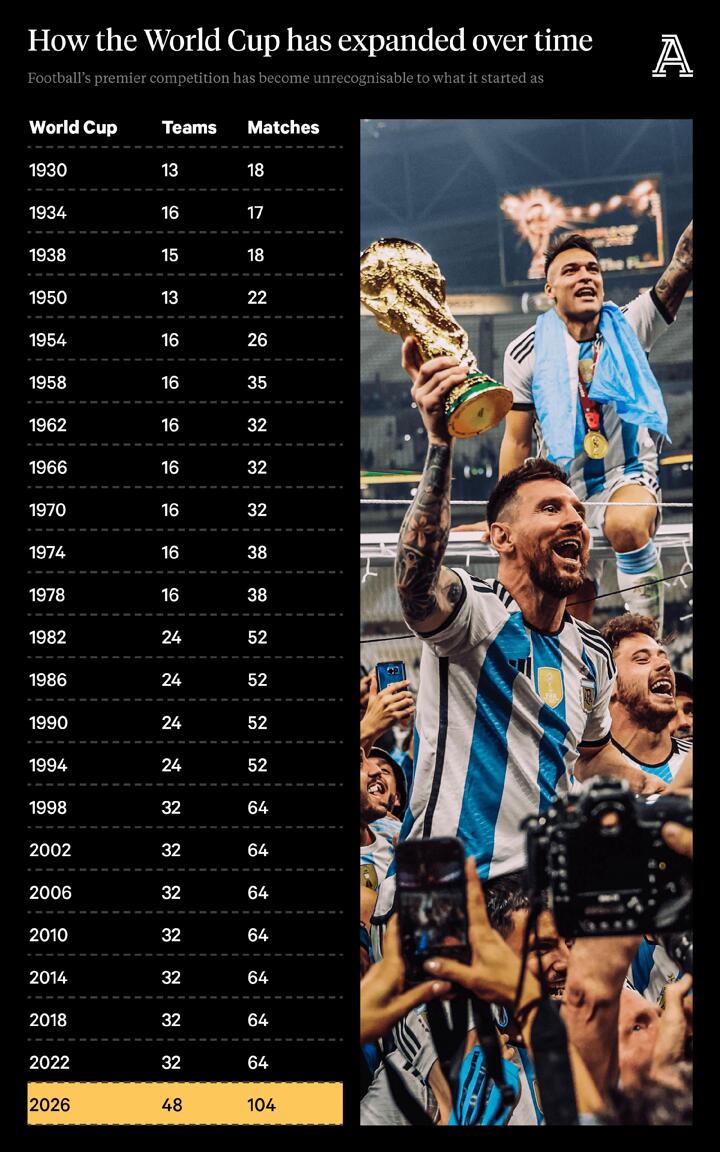
FIFA is set to expand the tournament's format to include 48 teams who will play 104 games between them at the 2026 World Cup, which will be held in the USA, Canada and Mexico.
There will be 12 groups of four, with the top two in each group, as well as the eight best third-placed teams, qualifying for the newly-introduced round of 32. The number of games the teams that make the semi-finals will play is eight — one more than Argentina, France, Croatia and Morocco played in 2022.
Overall, it means more football for fans to enjoy, but at what price?
More games will come at a cost
Ultimately, when the World Cup expands, the biggest winners are broadcasters and FIFA itself, because more games means more money. For players, it's not too different from your boss adding a clause to your contract that says you have to do more work with no extra pay, rest or holiday dates in return.
Extra games are a growing problem. As Liverpool and Netherlands defender Virgil van Dijk said, footballers are not robots. Just because they earn a lot of money, it doesn't mean they don't experience similar problems to people who earn far less. Calls for a better work-life balance or concerns around their mental health are valid.
Nobody is asking these players to come in on Saturdays to fill out spreadsheets and put together boring presentations. It's about as fun as extra work can get. But it's still extra work nonetheless.
The idea of having more World Cup games has merit but could increase burnout among players. So, what's the solution? Take from Peter and give to Paul.
When was the last time you marvelled at the fourth round of the Carabao Cup? Why does that competition even exist? At best, it's a footnote in a team's quest to win a quadruple.
Manchester United's win in the knockout round play-offs of the Europa League against Barcelona was fun. But it took place on a Thursday night, four rounds before the final of Europe's second-best competition. No more needs to be said about why that win isn't quite the historic European night it appears to be on paper.
The Community Shield features the winners of the Premier League and FA Cup. In theory, the winner should be viewed as the best team in England. In reality, it's a glorified friendly.
As for the Europa Conference League, nobody is cancelling their evening's plans to watch the second leg of AEK Larnaca vs Dnipro-1 in the knockout round play-offs.
The football calendar is littered with competitions that are excessive and for the most part, void of a constant flow of excitement. It's time to streamline.
If FIFA wants to expand the World Cup, they should work with UEFA and football associations to reduce the number of games in other competitions.
Expect drama
Another round in the knockout stages has led people to believe that there will be less group-stage drama. But is that actually true?
Drama is a relative term. To some, William Shakespeare's work still underpins a lot of modern-day art, while to others, drop “wherefore art thou?” into a regular conversation and they will look at you sideways.
The idea that group-stage drama would be lost under the new format overlooks the fact that the real drama takes place in the knockout stages. And there would be even more drama in the groups if more teams can qualify.
In 2022, all eight groups had at least three teams in contention to reach the round of 16 heading into the third set of games. In six of those groups, all four teams had a chance to qualify. Wales' route to qualification was highly unlikely, as they would've had to beat England by four goals, but it was still possible in theory.
But all eight of the fourth-placed teams had a chance to finish third at the 2022 World Cup.
If anything, the new format should lead to more twists and turns because there are more spots up for grabs. The race to finish first and second, and therefore get a more favourable draw in the next round, will still exist — only now, with the added bonus of the race to be one of the best third-placed teams taking place alongside it.
Cameroon beat Brazil and Tunisia beat France in their final group games in Qatar. And it meant nothing in the grand scheme of things.
Both countries finished third with four points and a goal difference of zero. Under this new format, they would've likely been rewarded for historic victories with a place in the knockout rounds, which is exactly what should happen if you manage to secure an unlikely win against two of the world's best teams.
The alternative format for the 2026 World Cup was going to involve 16 groups containing three teams each, but by the final round of games, the two teams set to play would know what they had to do to qualify — leaving the door open to collusion.
With four groups of 12, we'll still get to enjoy both final group games being played out simultaneously with far less chance of collusion.
The thrill of seeing a big side lose a knockout game is far more interesting than watching them exit during the group stage.
A three-game capitulation in the group stage is still fun but a win-or-go-home situation with the allure of extra time or penalties on the horizon will always provide more excitement.
Will there be too many teams?
Nostalgia and personal bias is often the driving force behind what we consider to be good.
For some people, it wouldn't matter which format the World Cup had or how many teams were involved because it'll never dethrone the personal memories they've attached to previous editions of the tournament.
Having said that, 48 teams is a lot. There are 211 teams in FIFA's men's rankings, which means 22.75 per cent of them will qualify for the next World Cup. There will be plenty of scope for games between smaller nations that casual global football fans might not necessarily care about.
But that's always been part of the World Cup. It isn't the European Super League. We're supposed to have matches between teams we'd otherwise never watch. That's part of the fun.
If there's another knockout round, there's more chance that a bigger side gets knocked out too. When big sides get knocked out, underdogs can become favourites, and more matches have relevance to casual fans, like what we saw with Japan and Morocco in Qatar.
With more matches, comes a greater need to use your entire squad. For all the clamour around James Maddison's inclusion in England's World Cup squad, the fact he played zero minutes in Qatar was quietly swept under the rug.
Frenchman Adil Rami has a World Cup winners' medal from 2018 but didn't play a single minute in Russia. For what it's worth if someone offered me a spot as a bystander in a World Cup-winning squad, I'd happily take it.
But seeing as I'm rubbish at football, I don't have to worry about that. I want to see all players earn their medals, not ride the coattails of the eleven who did all the heavy lifting.
Whilst there will be more fixtures, it's a slight tweak of the format we've already become accustomed to rather than a drastic turn in a new direction.
There will be more matches at the 2026 World Cup (104) than there were at the first five World Cups combined (101). It sounds like a lot but in reality, the 2026 format will feature one extra knockout round, fewer dead rubbers in the groups and smaller nations getting a chance to make history. That doesn't seem so bad.