


As Arsenal spent almost the whole second half of their 3-2 defeat to Manchester United chasing an equaliser, it never seemed likely they would create a clear-cut chance from open play.
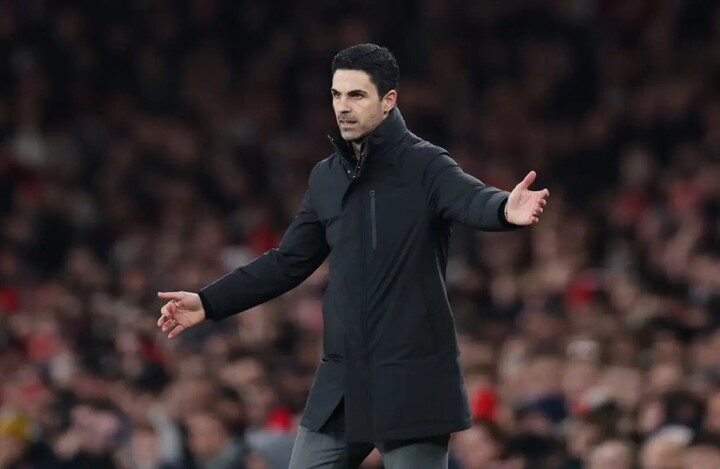
Arsenal are able to dominate possession, and to record a regular stream of goals from set pieces. But Arsenal’s inability to score goals from open play remains highly unusual for a side top of the table.
Take away penalties, set pieces and own goals, and they’ve managed only 22 goals from 23 matches this season. Manchester City (36), Liverpool (28), Manchester United (26), Aston Villa (24), Bournemouth (24), and Brentford (24) have all managed more, and Chelsea have managed the same number. This is despite Arsenal having the widest range of attacking options in the Premier League.
This is a period of football in which squad depth is vaunted like never before — it’s the five-substitutes era, and Mikel Arteta’s attempt to get back into the game yesterday involved a quadruple substitution, which would have been literally impossible until 2020. In that sense, football has changed. But equally, Arsenal are lacking a single outstanding attacker this season. And while there’s no particular need for one single attacker to dominate in terms of goalscoring, it’s very rare for a side to win the title without one standout attacker having an excellent individual campaign.
As a very general rule — backed up by an academic paper written by the late Garry Gelade, a Cambridge graduate who played an influential role in the development of football analytics — the quality of a side’s defence is determined more by the weakest defensive player, but the quality of a side’s attack is determined more by its strongest attacking player.
That basically makes sense. Defending is largely reactive, and opponents are able to target one player or zone. Attacking is proactive, and you can attempt to work the ball into your best attacker. But who is Arsenal’s best attacker?
In pure statistical terms, it is Leandro Trossard — nine goal contributions, with five goals and four assists. Trossard is clearly an excellent technician and has produced some crucial moments this season. But it’s also fair to consider that a player of Trossard’s ability should probably be a useful squad option for a title challenger, rather than the go-to man.
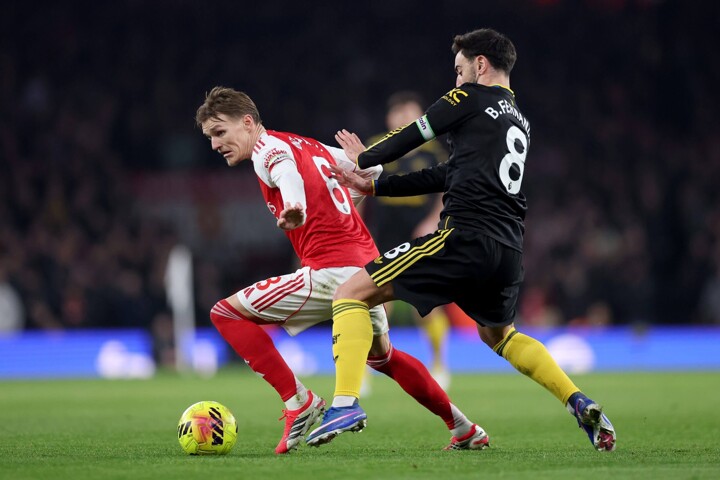
Arsenal’s outstanding individual, really, should be one of two players: Bukayo Saka or Martin Odegaard. Saka recorded 25 goal contributions in both 2022-23 and 2023-24, albeit boosted by penalties. Last season, hampered by injury, that dropped to 16. This season, again with fitness problems, he’s on just seven. Odegaard has suffered a similar drop: 22 goal contributions, then 18, then only 11 last season and just four this season.
The obvious point is that they are related to one another. At their best, Saka and Odegaard were the best attacking duo in the league. Two seasons ago, if you measured the passing duos in the Premier League that took the ball from outside the box into the box, Odegaard to Saka was the best combination, and Saka to Odegaard was the second-best combination.
And Odegaard, at his peak, had a maximising effect on team-mates. He seemed to have a genuinely special connection with each of the four other players in Arsenal’s effective front five — even Gabriel Martinelli, positioned way over on the left flank, seemed to thrive when playing when Odegaard was in his customary inside-right role.
Historically, there are no precedents for a Premier League title winner having their leading goal contributor (in terms of goals and assists) as low as what Trossard is on course to get. The most meagre top contributor was Kevin De Bruyne with 18 in 2020-21. But De Bruyne was nevertheless excellent that season; 12 of those 18 were assists, showing that he wasn’t simply starring himself but boosting others. He won the PFA Player of the Year award; it’s difficult to imagine any of Arsenal’s attackers will even be on the shortlist this time around.
There’s a suspicion that Arteta’s coaching sometimes constrains his players. But equally, he is fielding Saka and Odegaard in the same roles as when they were producing much better individual performances than this. Odegaard, in particular, does have a fair amount of positional freedom, able to come short and drift wide to receive the ball.
While Arsenal are evidently not short in terms of depth, they’re probably still missing Kai Havertz, who has appeared twice in cup competitions this month but hasn’t played in the Premier League since the previous encounter with Manchester United on the opening day. While not prolific himself, Havertz does offer better link play than the other three options up front: Gabriel Jesus, Viktor Gyokeres and Mikel Merino.
But another key player could be Ben White. While Jurrien Timber is having a good season and offers a surprising level of penalty box threat for a right-back, Arsenal’s right-sided attacking was at its best when White was fully fit, making overlapping runs to allow Saka inside into dangerous shooting positions, and get rotations going down that flank with Odegaard. That trio worked excellently together. It was interesting that as part of Arteta’s quadruple change yesterday, he introduced White in place of Piero Hincapie, with Timber moving from right-back to left-back.
Ultimately, Arsenal’s current approach has taken them to the top of the table: four points clear, and favourites for the title. But it feels like Arteta’s side will, at some point this season, require a burst of brilliance from an attacking player: the equivalent of Marc Overmars’ run-in in 1997-98, of Freddie Ljungberg’s in 2001-02. Lots of Arsenal’s attackers have it in them, and have shown that level within this system previously.
It doesn’t matter who, but someone in Arsenal’s attack needs to step up and lead the charge.