


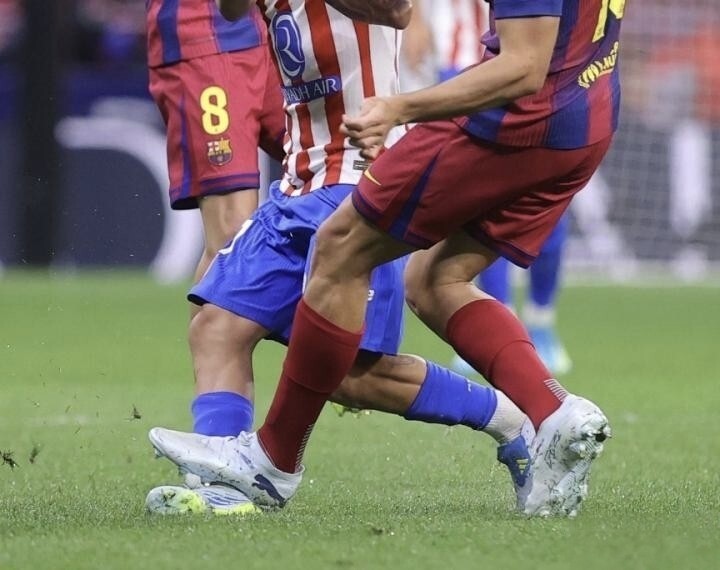
On April 8th, the Spanish Royal Football Federation updated the latest issue of "Review Time" on social media. The referee technical committee stated in the program that in the 30th round of La Liga, in the Atletico Madrid against Barcelona match, the action of Gerald Martín stepping on Almada should have been a red card, and VAR should not have intervened.
The following is a transcript of the video
Hello everyone, welcome to the new issue of "Review Time". In this column, we will combine the rules of football competition and the referee technical committee's penalty standards to analyze the most typical penalties of each round from a teaching and professional perspective.
In this issue, we will first look at two fouls that occurred last weekend, one at the Metropolitano Stadium, Atletico Madrid against Barcelona, and the other at the Mestalla Stadium, Valencia against Celta de Vigo.
These two actions seem similar, but there are essential differences at the technical level, which explains why disciplinary penalties should be different. The Spanish Referee Technical Committee (CTA) believes that such penalties are prone to controversy in football, so we will conduct a detailed analysis and supplement it with cases to help everyone have a consistent understanding of the penalty standards.
The first scenario: Barcelona player compete with Atletico Madrid player for a 50-50 ball, and both sides have a clear chance to touch the ball. Martin arrived first and kicked the ball, but in the subsequent action, the studs stepped on the opponent's calf side, above the ankle, also causing the opponent's joint to twist. The referee on the spot directly showed a red card for serious violent foul based on the comprehensive action intensity, impact part, and consequences. Subsequently, after the VAR suggested a review, the penalty was changed to a yellow card.

The second scenario: A Valencia player clearly controls the ball and passes it to a teammate, after which a Celta de Vigo player stretched his leg into the path of his technical action. The Valencia player stepped on the opponent when naturally landing to support their foot.

The core key to distinguishing such situations is: Is this a ball possession contest where both sides have a real chance to compete, or is it a contact caused by one side controlling the ball and completing the ball-out action, but being invaded by the opponent?
When both sides have a real chance to compete for the ball, the player who touches the ball first has priority in the competition, but still needs to be responsible for the subsequent consequences of the action. That is to say, touching the ball first does not mean that you can be exempt from subsequent reckless, careless, or serious violent fouls. The Atletico Madrid vs Barcelona foul, as well as the Betis vs Rayo Vallecano foul analyzed in the "Review Time" of the 22nd round on February 24 , both belong to this category.
The referee technical committee believes that both cases are serious violent fouls, and it does not matter who touches the ball first. The correct disciplinary penalty should be a red card.
On the contrary, when a player has controlled the ball, has priority, and completes the kicking technique, and the opponent inserts his leg into his kicking action and invades the ball-controlling player's space, the latter should pay attention and protect his own safety. In this case, the ball-controlling party cannot be held responsible for the consequences of the contact. The Valencia against Celta de Vigo foul belongs to this situation. Such situations should not be punished, because the contact is unavoidable and unintentional. According to the Referee Technical Committee's Notice No. 3 this season, it should be considered an accidental action.
At the same time, the referee must also judge whether the player has any additional active actions to seek contact with the opponent when kicking the ball. If it exists, the action should be punished and judged according to its nature.
Since the beginning of this season, the Referee Technical Committee and many domestic and foreign referee organizations have maintained a consistent and consistent penalty standard. The referee's initial penalty for this obvious ball contest was correct. The referee technical committee believes that VAR should not have intervened, because the referee on the field judged accurately. The VAR's suggestion for review led to an incorrect change of a move that was originally judged correctly, and the referee should have insisted on the original decision.
At the Mestalla Stadium, although the referee did not have to penalize the foul with a direct free kick, his judgment on the nature of the action was correct, and no additional disciplinary action was taken, which was handled properly. VAR did not intervene, and the approach was correct.