


After officially taking up his role as technical director of the Italian Football Federation, Paolo Maldini attended the federation's press conference together with Leonardo, who serves as his adviser.
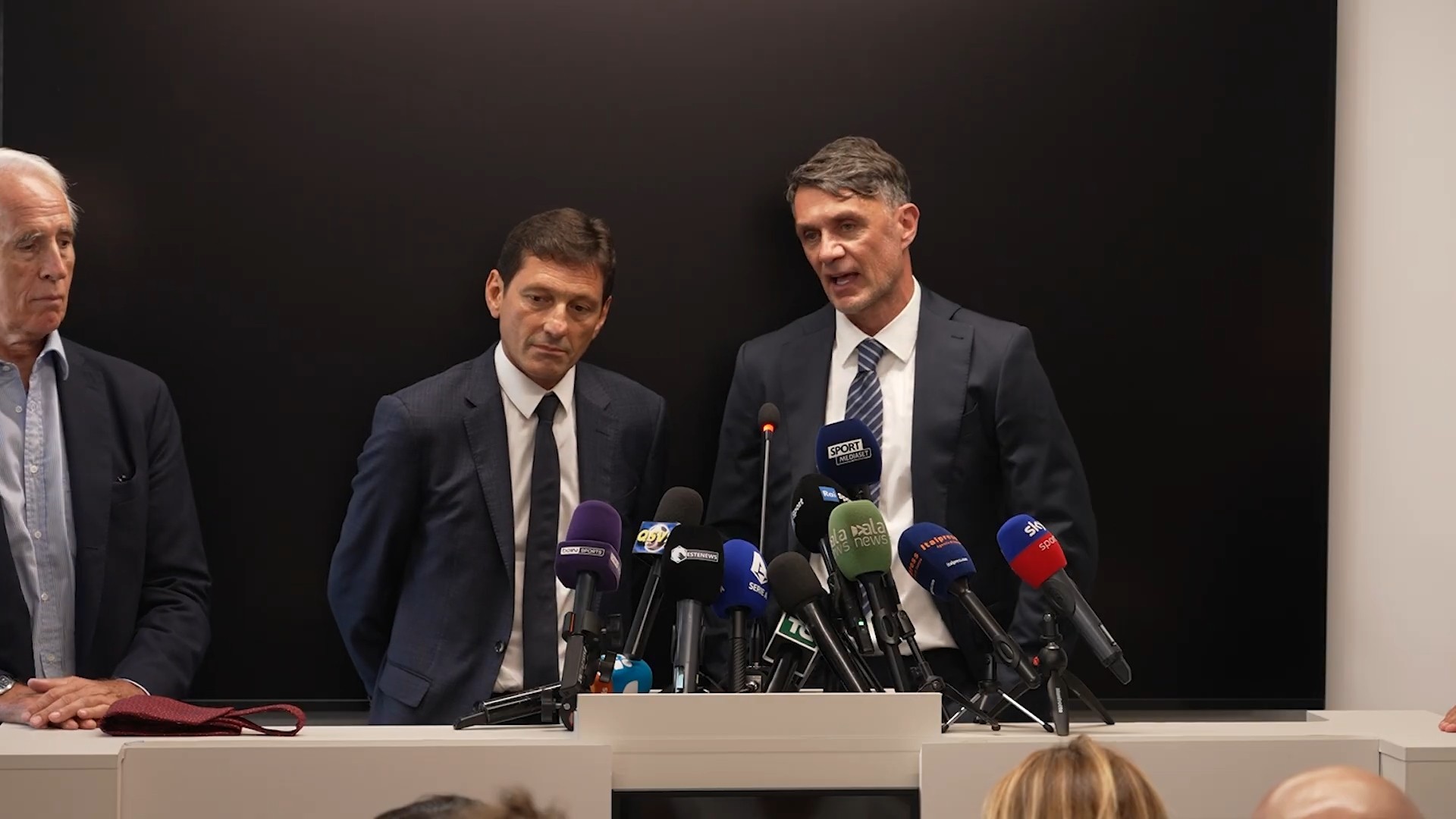
Regarding the point just mentioned, I would like to ask whether you can give us some insight into exactly what vision you have for the new “Club Italia” (that is, the national team management system). What do you want to innovate within it? What do you want to change completely? What exactly are the core pillars underpinning your plan?
Maldini: “First of all, my position is one that did not exist before, namely Technical Director of the Italian Football Federation, and together with my friend and adviser Leonardo, we will try to provide the ‘Italian clubs’ with a technical philosophy and a technical structure, which is precisely the technical side of the federation. So, to be able to establish this role together with the president, I think, is already a sign of enormous change, and I believe it will also greatly improve communication among all the components we mentioned earlier. There has never before been a technical management structure capable of bringing together ideas and relationships, and in my view that will be crucial. (turning to Leonardo) If you would like to add a brief thought...”
Leonardo: “In particular, the federation lives in three worlds: the senior national team is obviously the face of it all, then there are the youth national teams, and the technical department. There is no need for us to revisit the past here; that would serve no purpose. We have to look ahead. Our idea is for this technical leadership to become the leader of all these worlds, because at present they have some difficulty interacting. So our idea is to build something very clear and very concrete, with a philosophy that can be transmitted from the top down, even reaching the youngest teams made up of eight-year-old children.”
“This kind of situation has happened at many clubs; it is nothing new. The Italians know what to do; Italians are well versed in every aspect of balance. But, for one reason or another, we have never managed to bring these forces together and put them into practice. And in reality, Italy is now at a level that everyone understands; we are all aware of the difficulties today. So the key now is to bring everyone together and create a wave, one that will be focused primarily on the technical side.”
“I believe Italian football has fallen behind on a technical level. Today’s game places great emphasis on one-on-one situations, on dribbling, and on breaking through with pace, and right now we lack initiative in that regard. So we really have to give the lads that freedom, including the players who are currently playing for the national team. Our choices will be based to a large extent on that, on a technical issue, on a technical methodology. We want that methodology to spread everywhere, so that it becomes a style of football that is very strong in attack. This is no longer just one aspect of the game; it is an urgent requirement in modern football.”
In your own words, we built this “chain of persuasion,” right? How did this develop? I’m asking you, Paul, because we understand why it was ultimately a “Yes,” but why was it a “No” at first? Why did you have to be “convinced”? And what was the ability you were assessing?
Maldini: “Why did I need to be fully convinced? Because, to be honest, at the time I did not fully understand such a complex competitive environment, nor did I understand just how difficult it would be to bring together all the varied components within the football federation, each with their own different interests. But in the end, I truly felt a sense of ‘fresh air’, and I sensed that there was a real possibility here to accomplish something great.”
“And I have felt, from every part of the organization, an extremely strong shared desire to be involved in this historic transformation. Everyone is certain to benefit from this change, and everyone should be closely involved in this vast project. As things stand today, this has become unmistakably clear to me, and that is of enormous importance. Of course, beyond these objective factors, one must also add the president’s extraordinary and highly compelling powers of persuasion.”
Good afternoon, everyone. I’m very sorry if I have to return once again to the subject of the head coach. I’m not trying to press you for a specific name, but perhaps we in the media have misread the information. Aside from Guardiola, many names with completely different tactical styles and personalities have been mentioned frequently. I’d like you to describe in detail whether there is a clear “profile” for the future head coach. If there is, what exactly does that profile look like? Because, obviously, Conte and Guardiola are entirely different types of coaches...
Leonardo: “As for the head coach’s ‘profile,’ this is in fact the core issue we have been discussing today: we need to look for a coach whose way of thinking and footballing philosophy can, to a greater or lesser extent, be closely aligned with the technical management team, meaning us. Coaches with many different tactical profiles can deliver victories; that is an undisputed consensus in football. The real key is to find a level of intellectual alignment and harmony between the coach and the technical management team.”
“Honestly, because this entirely new structure has never existed before, in my view we have all somewhat forgotten how such a system is supposed to operate efficiently. But remember, the technical management is not there to issue orders and direct everything; you are simply there to set a broad direction and a clear path for the head coach.”
“I really don’t want to go back to the way things were. Up to now, the traditional structure has been a federation president plus a national team head coach, with that coach more or less the sole person in charge of everything. His main focus was not on the technical department, but also overseeing the youth national teams. That is extremely difficult, because coaches are changed every two or three years depending on results, which means you can never establish a long-term, stable development pathway. Our core idea is to establish a direction, a training methodology that can truly run from top to bottom through every level. There is no doubt that this is something that takes a great deal of time to bed in. At the same time, we also have to move forward steadily on the practical side with the national team, because on the 25th of this month we immediately have a real match to play.”
Good afternoon, and first of all I sincerely wish you all the best! Paul, what I wanted to ask you is this: you said earlier that appointing a head coach as quickly as possible is not the most important thing, and that what matters more is finding the absolutely right person. I think all of us have the same person in mind right now, namely Guardiola as the key point of reference. So, based on what you are currently able to disclose publicly, up to this point, are the doubts in his mind more due to personal-life reasons, or are they related to contractual factors?
Maldini: “No, honestly, even now we really cannot disclose anything substantive about what is happening behind the scenes. You have been very perceptive in identifying one of the targets we may have set, and we certainly have no intention of hiding it: before speaking with Pep, we also had in-depth talks with Carlo Ancelotti. To be honest, we felt it was absolutely right and necessary to begin by approaching those we consider to be among the very best coaches in the world today. So we needed to carefully assess their overall willingness to take the job. At this stage, I can only talk to you about the term ‘overall willingness’.”