


Of all the issues for Mauricio Pochettino when he finally checks in at Manchester United this week, it says a lot about the reign of confusion at Old Trafford that the biggest puzzle is the player who swept last season’s footballer-of-the-year awards.
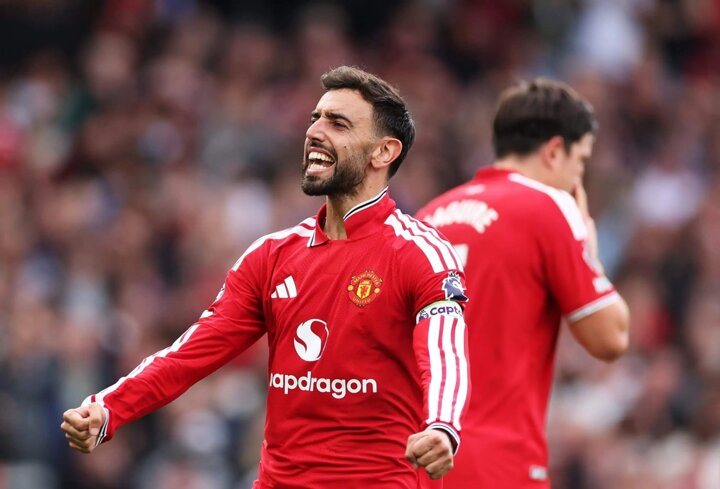
It doesn’t really make sense, does it? It is only a few months since we saw Bruno Fernandes collecting the gongs that anointed him as the best performer in the Premier League. In ordinary circumstances, his presence at Old Trafford should reassure an incoming manager. And, maybe in some ways, it still is.
But it is also a reality of life on Sir Matt Busby Way that you have to take the good with the bad when it comes to the club’s captain. The good tends to outweigh the bad but there are plenty of people — Michael Carrick, for one — who can testify that it is a close-run thing sometimes.
This season, the balance has started to tip the wrong way, and Pochettino will know, presumably, about the show of mutiny from Fernandes that cranked up the pressure on Carrick after United’s 4-1 defeat at Como in the Champions League last month.
Carrick’s response to Fernandes publicly questioning the team’s tactics — and, therefore, his management — was to drop his captain from the following game at home to Bournemouth. It was a decision that attracted considerable backing from United’s fans, certainly those old enough to have followed the team in Alex Ferguson’s years as manager. But the effect would have been much greater if it had meant any meaningful change. United were beaten again, losing 3-0, and Fernandes has been back in the starting line-up ever since, albeit still playing some way off his best.
The question is whether Pochettino thinks the good outweighs the bad, and presumably, he would agree that there is a thick portfolio of evidence to say that, yes, it does.
We know Pochettino likes the attacking midfielder because he was the manager at Tottenham Hotspur in 2019 when the London club tried to sign Fernandes, then at Sporting CP.
We can also be fairly confident that Fernandes will understand, or quickly be made aware, that he would be unwise to push his luck when it comes to the new manager. Pochettino is absolutely no pushover and we have seen before that he is not afraid to cut someone down to size, captain or not, if he sees something he does not like.
One of Pochettino’s first acts upon taking the Tottenham job in 2014 was to bring together a group of senior players and ask them to nominate who should wear the armband. Younes Kaboul took the role. Then, 11 games into the season, Pochettino removed Kaboul from the team and the Frenchman did not play another minute for the club in the Premier League. The captaincy went to Hugo Lloris, on Pochettino’s say-so, and Kaboul was sold the following summer. To repeat: Pochettino is very much the boss.
Nobody should make any wild assumptions that the same will happen to Fernandes. Far more likely, the new manager will make it his priority to lift United out of the relegation zone, and a big part of that, almost certainly, depends on his ability to get the 32-year-old firing again.
Pochettino needs to soothe United’s tensions, not create new fires. He is also smart enough to understand that the art of good management often means pandering to a star player’s ego, just as United once made special allowances for Cristiano Ronaldo and, before that, Eric Cantona.
At the same time, who could blame Pochettino if he has a few reservations about Fernandes’ suitability for the role when there is another pile of evidence to suggest that, though the player clearly cares for the club, he might care for himself a lot more?
Many United fans have grown weary of the small army of ex-players who have picked up the microphone after their playing careers and can be cutting, to say the least, when it comes to the current team’s failures and, intermittently, its captain.
But that doesn’t necessarily mean what they are saying is wrong. Roy Keane, in particular, called it right with his assessment of the extraordinary levels of indulgence when Fernandes broke the Premier League’s assist record last season and what, in turn, it said about the club’s jumbled priorities.
To recap, United have not won the league since Ferguson’s last season, in 2013, and have spent most of that time watching Manchester City, Liverpool, Chelsea and Arsenal sharing the big trophies. United, post-Ferguson, haven’t even been involved in what could be described as a genuine title race.
It has been 13 years of underachievement — a tragicomedy, a madhouse, a shambles; call it what you will — for the most part. So what does it say about United that, in the same two-week period that City won the FA Cup and Arsenal collected the Premier League trophy, Fernandes’ accumulation of assists brought forward pitchside presentations, giddy social-media posts and people at Old Trafford who sounded like it was an achievement worthy of his own open-top bus parade?
You might not like Keane’s delivery sometimes (he called it a “circus act”) but it was difficult to argue when he said that a better captain, at a club of United’s size and supposed ambition, would have realised how embarrassing it looked to be so fixated on a record that was not even a thing, on anyone’s radar, a few years earlier. Fernandes did not appear to understand that.
Six months on, we are now taking in the news that the player in question has turned down United’s latest contract offer, having also declined to accept what was put on the table in the summer.
That in itself creates another layer of uncertainty at a time when United, in 18th, have rarely looked more vulnerable. But let’s not just assume it means he is trying to get out. It is just as likely that it is a negotiation tactic, as often seen in the football industry, to bump up the numbers. Everyone knows Marcus Rashford is the club’s top earner on £325,000 ($430,000) a week, so it’s inevitable that Fernandes will be expecting some mind-boggling numbers, too.
Whether United let him get what he wants is another matter entirely. Recent events don’t count in his favour. And besides, there is no dramatic rush to get it sorted — not if the club are sensible about it, anyway.
A release clause for overseas clubs, set at €65million (£54m; $72m), expired earlier this year and United have an option — one they will surely trigger — to extend the player’s deal by 12 months to the summer of 2028. Fernandes turns 34 at the start of the 2028-29 season. His age has to be a consideration and, though it is difficult to put too much faith in the people at the top of the club, surely the intention is for United to find someone between now and then who can take over as the team’s most creative influence.
History, through a United lens, will remember Fernandes fondly when that day arrives. He should also make his 99th appearance for Portugal in their Nations League tie against Wales on Tuesday. Fernandes is expected to lead out the team, even though Jorge Jesus, Portugal’s coach, notably named the now-injured Bernardo Silva as the team’s new captain in Cristiano Ronaldo’s absence. Next, Fernandes will become the ninth player in history to win 100 caps for his country.
It is a career, in other words, that deserves respect and admiration. But this is a new start for United — the eighth change of manager, permanent or interim, since Fernandes joined in January 2020 — and that makes it a good time for the reigning player of the year to remind everyone, not just Pochettino, why the good outweighs the bad and he is worth the occasional hassle.