


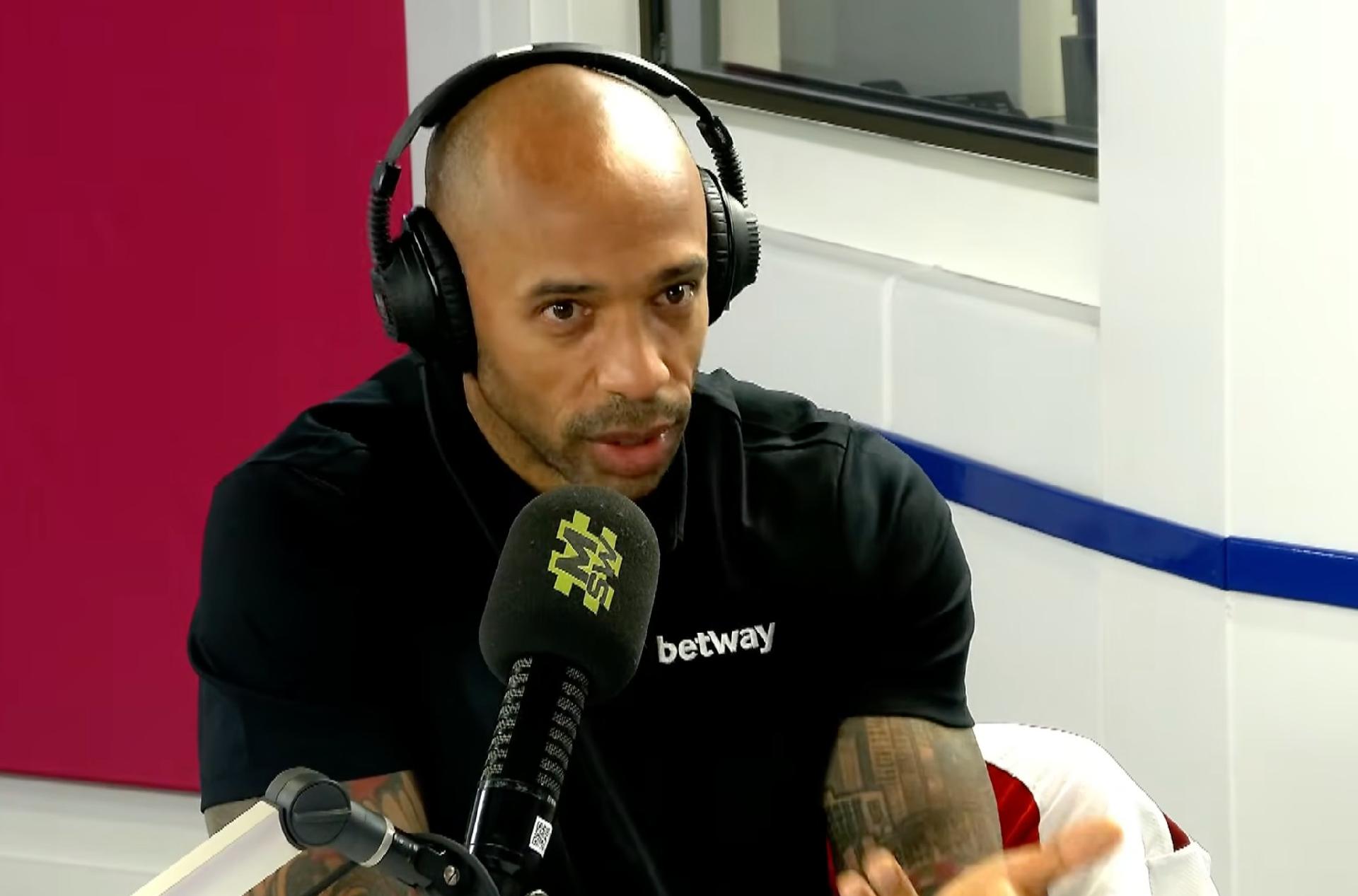
Arsenal legend Thierry Henry joined Robert Marawa on his show, Marawa Sports Worldwide, for an exclusive interview. Henry reflected on his playing career, discussing his time at Arsenal, his feelings before the 1998 World Cup match against South Africa, and his views on VAR. This is the second part of the exclusive interview.
But Thierry, did any coach ever try to suppress your talent? In the end, we saw your talent and what you could achieve through persistence and an understanding of your own abilities.
You have to show people what kind of player you are. That's what I've always thought. Some people can see things in you that you haven't even recognized yourself. At some point, I probably knew what kind of player I wanted to be. But if you want someone to give you that freedom, to hand you the keys, you have to prove to them that you can do what you say you can do, or play the way you want to play.
There was one person who was very important to me. You just said that maybe some people didn't see it, but that wasn't the case; it was simply a continuous process of development. I played as a wing-back at Juventus, and I also won the World Cup as a winger. Then I returned to the No. 9 position because that was the role I had been trained to play when I was young.
At some stage, you bring all of this together: playing as a wing-back, playing as a winger, winning the World Cup as a winger, and winning the league title as a winger at Monaco. Then you think: "Okay, let me combine all of this and become the No. 9 I want to be."
Arsène Wenger opened that door for me, opened my mind, and gave me the freedom I needed to make the most of my abilities. But as you said, you really have to deliver because, whether you're at Arsenal or any other team, at some point you'll end up on the bench. You might want to be a certain kind of player...
But you can't.
Exactly.
You mentioned winning the World Cup. What do you remember about winning it for the first time?
There was a lot to it. As I said, I've been doing a lot of media interviews recently. I have a very special connection with South Africa because my first game was against them, right?
And your first goal, too.
It was against South Africa. My first World Cup match was against South Africa, and so was my last World Cup match, which was also my last match for France. So, yes, I always remember that; it has stayed with me.
We can talk about that World Cup because there was so much to it: Lilian Thuram scoring two goals in the semi-final, Zidane scoring two in the final, and me being part of that team, among other things. But since I'm here, I want to talk about my first World Cup game.
I was about to make my World Cup debut against South Africa in Marseille. We were all a bit nervous because, don't forget, France hadn't qualified for the 1994 World Cup or the 1990 World Cup. And we were facing the African champions, who were a very good team.
People weren't sure how we would perform. I remember standing in the tunnel, looking toward the pitch and seeing the South African players coming out, dancing. I thought to myself: "These guys are dancing, and they're about to play a game." Meanwhile, we were nervous. They were dancing, singing, and chanting. I watched them, thinking: "What's going on? These guys are way too relaxed; I'm not comfortable at all." That was one of only two games in my career when I truly felt scared.
In 1998 against South Africa?
Yes, because I realized the magnitude of the occasion. Going back to what you just said, it was a World Cup at home. Before that, I was young and reckless, and I didn't care about anything. Suddenly, I started thinking: "I'm going to play in the World Cup. France missed the previous two World Cups, and I shouldn't even be in this team. My family is in the stands. Don't mess this up."
Before, I would think: "I'm going to charge forward, I'm going to break through everything, no one can stop me." But at that moment, I realized the magnitude of the occasion, which made that feeling even stronger. Then I turned around and saw the South African players dancing.
I thought, "Wait, what's going on?" After that, we can go back to talking about winning the championship and other things.
But first, you broke our hearts because that was our first World Cup in 1998.
It was my first, too.
I know, I know. So it was a first for everyone. You should have let us win. You should have enjoyed their dancing, maybe even joined them. But listen up: it’s this gentleman sitting right here who broke our hearts. Oh my goodness.
But as I said, I was very young then. I grew up watching that South African team win the Africa Cup of Nations, and I saw the impact it had on the country and how much it meant. Your team had Masinga, Radebe, Fish—I won’t name them all...
I must say, you still remember their names.
Of course, the name "Doctor" Khumalo is even more special. Considering everything that was happening in the country at the time, I don't remember any other team receiving such universal support as that South African team did when it won the Africa Cup of Nations. The whole world wanted South Africa to win.
When you say it was your first World Cup, I think about what that team meant to so many people around the world and what was happening in the country at the time. It was very moving. I think everyone felt it when you won. But twelve years later...
You got your revenge.
No, but you won when we faced each other in my last game, so you got that win back.
Yes, but you also came to South Africa in 2010, and that wasn't the best French team. Let's not talk about that.
But you won—you won.