


Donald Trump has criticized Australia for 'making a terrible humanitarian mistake' by potentially allowing the Iranian women's football team to return to their home country.
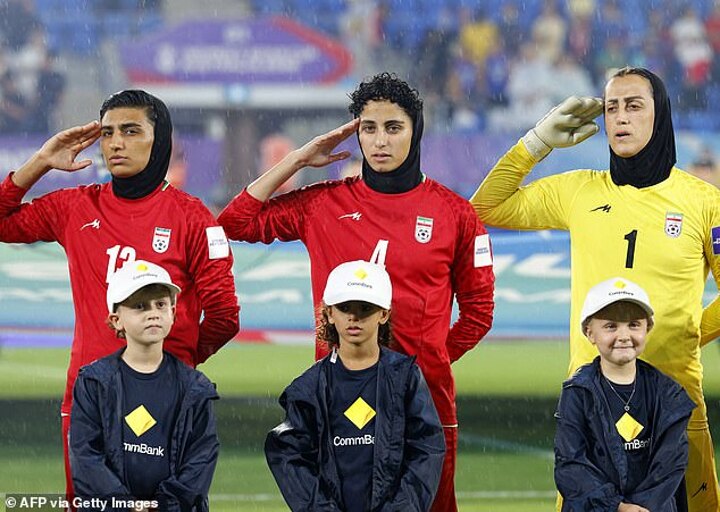
Trump's comments comes amid uncertainty over the players' future after they were branded 'traitors' by Iranian media for refusing to sing the national anthem before a game against South Korea at the Asian Cup last week, which is being hosted in Australia.
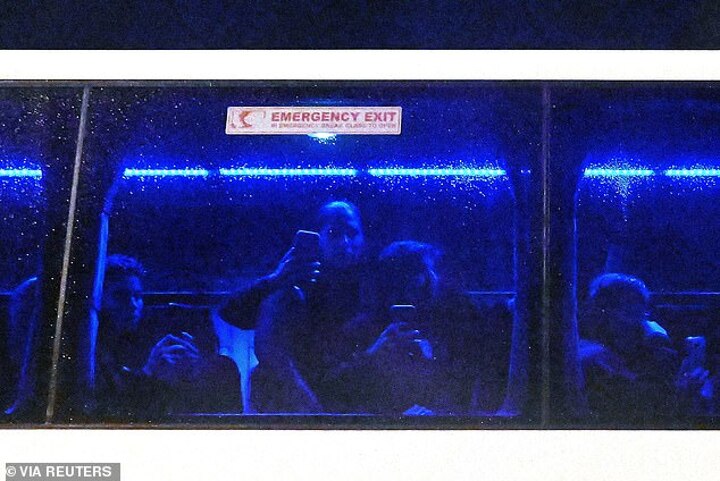
Then, one of the Iranian players could be seen performing the international SOS distress signal from inside the team bus after a game on Sunday, according to reports. She tucked her thumb into her palm and folded her fingers down over it - the recognized sign that someone is pleading for help.
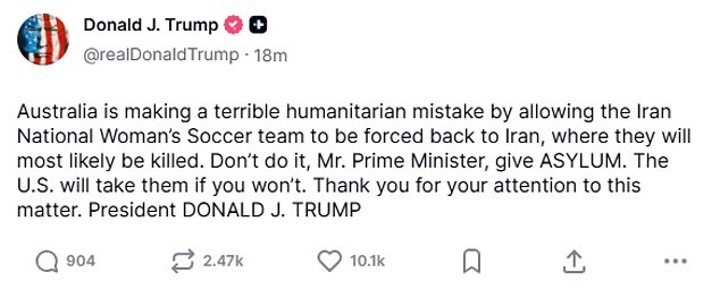
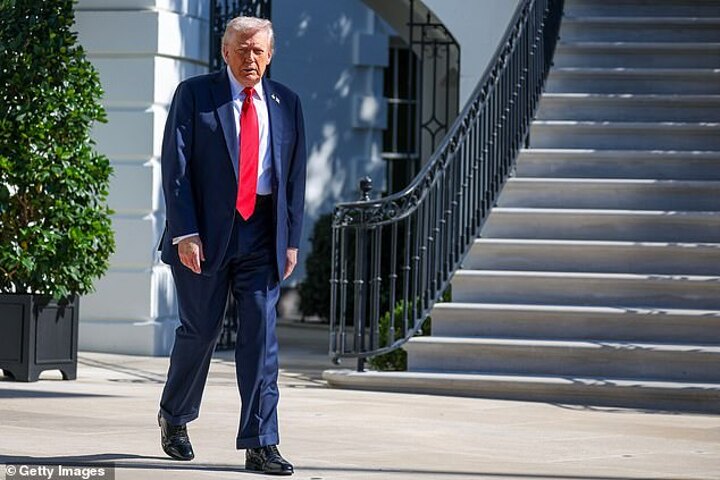
Trump wrote on social media: 'Australia is making a terrible humanitarian mistake by allowing the Iran National Woman's (sic) Soccer team to be forced back to Iran, where they will most likely be killed.
'Don't do it, Mr. Prime Minister (Anthony Albanese), give ASYLUM. The U.S. will take them if you won't. Thank you for your attention to this matter. President DONALD J. TRUMP'.
Trump's intervention follows reports that five members of the Iranian women’s team have already left the squad’s training camp and successfully sought refuge in Australia.
The office of Iran's exiled crown prince, Reza Pahlavi, said he had been told the players - Fatemeh Pasandideh, Zahra Ghanbari, Zahra Sarbali, Atefeh Ramazanzadeh and Mona Hamoudi - are now in a 'safe location'.
The five players were moved earlier on Monday from their Gold Coast hotel to a safe house managed by the Australian Federal Police and other authorities.
Writing on X, Pahlavi added: 'These five courageous athletes, currently in a safe location, have announced that they have joined Iran’s national Lion and Sun Revolution.'
The Lion and Sun refer to Iran's original flag, which predates the 1979 Islamic Revolution and is used today as a symbol of resistance against the current regime.
Last week, Iran's state-controlled television labelled the players' silent protest 'the pinnacle of dishonour' and 'the height of shamelessness and betrayal.'
Presenter Mohammad Reza Shahbazi warned on air: 'In times of war, traitors must be dealt with more harshly. Anyone who takes even a single step against the country during wartime must face stronger consequences.'
The team has not made any official statement on their stance, but they sang and saluted the national anthem in their following two games against Australia and the Philippines, raising concern that they had been forced to do so.
Prominent Iranian-American activist Masih Alinejad also called for the Australian government to step up, posting on X on Sunday night: 'Hello Australia, this is your moment. We need your support. Iran's women's football team refused to sing the regime's anthem right after the killing of Ali Khamenei.
'State TV called them “war-time traitors.” Now they're on a bus back to Iran, flashing the SOS hand signal through the window. I call on Australian government to them. Don’t send them back to danger. Please give them protection.'
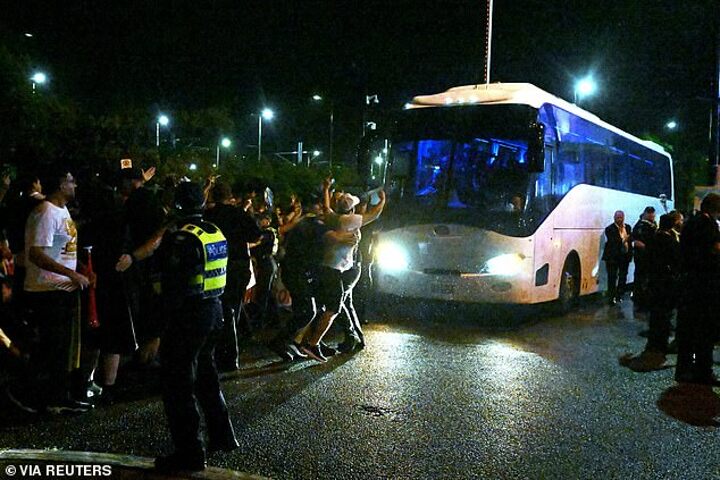
The Iranian women's competition came to an end on Sunday night when they were beaten 2-0 by the Philipppines in Queensland. After the match, around 200 protestors surrounded the team bus, banging on it and chanting 'let them go' as police pushed the crowd back.
The team have been staying at the Royal Pines resort on the Gold Coast and are due to leave Australia later this week.
Pahlavi, an Iranian dissident in exile in the US, had earlier said the team faces an 'ongoing threat' following their opting not to sing the anthem.
'As a result of their brave act of civil disobedience in refusing to sing the current regime's national anthem, they face dire consequences should they return to Iran,' he wrote on social media.
The Australian government have come under considerable pressure to ensure the team's welfare is protected following the end of their tournament.
Community groups have written to Home Affairs Minister Tony Burke, pleading with him to intervene on behalf of the women.
Rana Dadpour, the founder of Australian women's rights group AUSIRAN, said government officials should organise private meetings with the team members before they leave the country, warning they could face execution if they return home.
'We need to talk with these girls away from the handlers and the regime-affiliated people who are following them right now in Australia,' she said.
'If they want to stay, I think we need to provide them with every support that we can.'
While government officials have been reluctant to discuss the team's plight, fearing the publicity could put the women and their families at further risk, Ms Dadpour said global pressure was often effective on the Iranian regime.
'We've had many cases of execution orders that have been previously delayed or stopped only because of the international pressure and media attention,' she said.