


According to the report by "Football and Finance", recently, UEFA Marketing Director Guy-Laurent Epstein attended the SPOBIS conference held in Hamburg, where he discussed the new format of the UEFA Champions League in a panel discussion. This conference is one of the most important events in the European sports industry and innovation field.
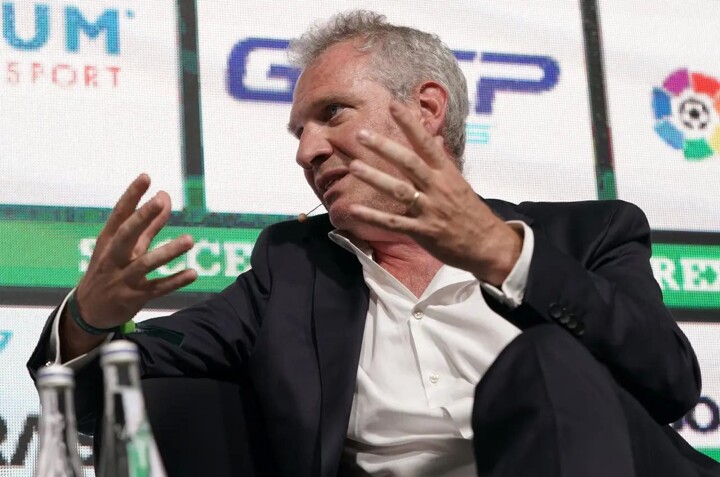
In his speech, Epstein first clarified a common misunderstanding, explaining that the new format was not designed for commercial considerations but to enhance the sporting value of the competition: "Launching the new format is not a marketing process; it is a sporting process aimed at improving the competitiveness of the tournament. Authenticity is crucial. One of football's great strengths is its high level of authenticity, and we must preserve that. Some new formats struggle to find their place."
The reasons behind the birth of the new Champions League
For this reason, the UEFA executive believes that the core of the tournament structure remains sports-first, although the development of the tournament cannot be separated from its media and commercial environment. Epstein clearly stated: "Therefore, the format itself is still sports-first. But in the process of sports development, we also take into account the media and commercial aspects." A concrete example is the increase in match weeks: "For our broadcasters, a key demand is to shorten the gap from mid-December to mid-February, during which there were no matches in the previous format."
As Epstein himself explained, this demand is particularly strong among pay TV stations, and he emphasized: "Especially for pay broadcasters, having Champions League matches in January is crucial because people renew their subscriptions after Christmas. We have also taken this into consideration." Therefore, adjusting the overall arrangement of international match schedules became necessary: "If you increase the number of international matches, you have to adjust the schedule. We found a match window that didn't exist before."
In Epstein's view, the balance lies in taking both dimensions into account: "The core is still sports, but we also meet commercial needs." This logic also responds to the demands from the football world itself: "If you increase the number of match days as required by the sports level, clubs, coaches, and players—because high-level international matches are now perhaps the holy grail of football—you have to create a schedule that can accommodate this number of matches." In this sense, UEFA found an underutilized time slot: "We discovered a window during a period when there were no matches in the past. Therefore, the core is still sports, but we also met commercial needs while developing sports."
The decuiding process of the new format
Epstein then talked about the process of adopting the new format within UEFA, admitting that even within UEFA, this change was not achieved overnight.
"We are deeply convinced of the new format," he explained, but added, "It took us a long time to reach internal consensus because in football, we are taking every decision very seriously." This conservatism is closely linked to tradition: "Football has its traditions, and we are accustomed to specific competition methods. Any change in the competition method will make people feel a little uncomfortable." Even fans did not fully understand the new model at first: "Perhaps fans did not really understand the concept of canceling the home-and-away system."
This adaptation process also involves clubs, Epstein emphasized: "Clubs may also not fully understand the importance of winning every game and scoring as many goals as possible." This was fully reflected in this season: "We saw this from the impact of Real Madrid's match against Benfica this season." Especially the last match day of the group stage became a watershed: "The final round of the group stage pushed everything to a climax, and the changes in club rankings were incredible."
Epstein believes that the new format has brought unprecedented unpredictability: "Some teams that had no hope of qualifying before successfully advanced, while some teams that were sure to qualify were eliminated. This would not have happened in the past because the previous qualification process was more stable."
This dynamic change has accelerated competition and made clubs realize that their fate does not depend entirely on their own on-field performance: "You are subject to the results of all other matches."
In this context, the weight of goal difference and the number of goals scored has also become crucial. Epstein recalled: "The final round once again proved that through that famous showdown, goal difference or the number of goals scored is crucial." A symbolic example is Marseille, which was eliminated because its goal difference was 1 less than Benfica's.
In the view of this UEFA executive, this is one of the most attractive elements of the new system: "This is the beauty of the new format. I would say that in the final round, we scored 61 goals in 90 minutes, and the rankings fluctuated up and down. This is an incredible entertainment experience."
Two phases of the new Champions League's commercial operation
Epstein explained that the new format has gone through two distinct phases. "The commercial operation of the new format is divided into two phases," he said, clearly pointing out, "One phase was completed before 2024, when we first launched and sold the new format." In the initial phase, UEFA presented a vision to the market: "We sold a promise, and our partners accepted this promise.Compared with the old format, after the implementation of the new format, our revenue has increased by more than 25%."
He believes that the reason for this success lies in the solidity of the project: "Partners accepted this promise because they saw its value." This work requires time and explanation: "We spent time explaining and analyzing, just like we did internally, showing all the advantages and all aspects of improving the quality of the tournament."
Among them, Epstein mentioned "each team plays against all opponents, there are strong matches every match day, and teams in the first tier play against each other, which was not the case before", in addition to "the number of match days increased from 6 to 8". Not to mention "the addition of a play-off stage" and "another knockout stage to balance the length of the group stage".
Market feedback confirmed the correctness of this choice: "Before the first match started, partners had already accepted it. Therefore, it has achieved commercial success with just a promise." Now, with the implementation of the new format, UEFA has returned to the market: "So far, the feedback, choices, and cooperation processes we have obtained in the European market are extremely positive, far exceeding the first cycle." Epstein's summary is very clear: "So yes, this is a commercial success. But again, it is first a sporting success, which then leads to commercial success."
TV broadcasting rights remain core
The issue of TV broadcasting rights remains core. Epstein believes: "Competition between major channels and platforms is clearly beneficial to us." And this competition was prompted by UEFA: "We created the right timing and format, and brought it to the market at the right time."
However, competition does not play a decisive role in all markets: "Some markets have no competition, but the business still operates well. For example, in Spain and France, we renewed contracts with the same partners. In France, it is Canal+, and in Spain, it is Telefónica. We are very satisfied with these commercial agreements."
Another core issue is to achieve global monetization without changing match times. Epstein reiterated that the core remains European audiences: "We return to the authenticity of the tournament and the interests of European fans." This is a clear bottom line: "We cannot schedule matches in time zones that are unsuitable for European fans. Matches are held in Europe and on weekdays. You cannot hold an empty-stadium match at 2 pm." In Epstein's view, this "is wrong for players, clubs, national teams, and fans, so we will not change the kick-off time."
This choice means that it is less flexible than national leagues because "they can schedule matches from 1 pm to 8 pm and offer these time slots to the world. We cannot." However, some markets are naturally suitable: "The time zones of Africa and the Middle East are similar to ours. The United States is different, but we provide the top-level football there."
He believes that the product still performs well in the U.S. market: "In the United States, the Premier League and the Champions League are very popular. Matches are held in the morning or noon, but the ratings are still very high." In Latin America, this tournament is "extremely popular, especially because Brazilian and Argentine players are the protagonists of the tournament." Therefore, "time is a problem, but it is not unsolvable."
Regarding the issue of holding official Champions League matches outside Europe, Epstein's attitude is very firm: "Holding a single Champions League match in the Middle East or Asia? Impossible. Holding official matches outside Europe will harm the interests of local fans of the clubs, and we will not promote this direction. I fully agree with the president's view."
The future of Europe's top club competitions
Looking to the future, Epstein expects no major changes to UEFA's competitions. "I don't expect major changes to UEFA's competitions," he explained, recalling, "We have done a lot of work over the years, developing the UEFA Nations League and launching new formats for club competitions." Similarly, "We adjusted the qualifying stages of the men's and women's European Championships to make them more attractive." Therefore, "I think our work on the football level and competition competitiveness has been completed."
His vision is stability: "So I don't think football will evolve much. The future is uncertain. But I think our current situation is very strong and will last for a while."
Future evolution may focus on other aspects: "For us, evolution may lie in which platforms we focus on, how we distribute content, and whether there is space for global content distribution." Especially the monetization methods outside the match: "When it comes to money, how do we monetize content outside the 90-minute match?"
This is an open challenge facing the entire industry: "All sports entities are good at monetizing live broadcast time slots. How do we monetize outside live broadcast time slots? This may be the future direction."