


The renovation of Barça's Camp Nou is now facing serious cost overruns and delays.
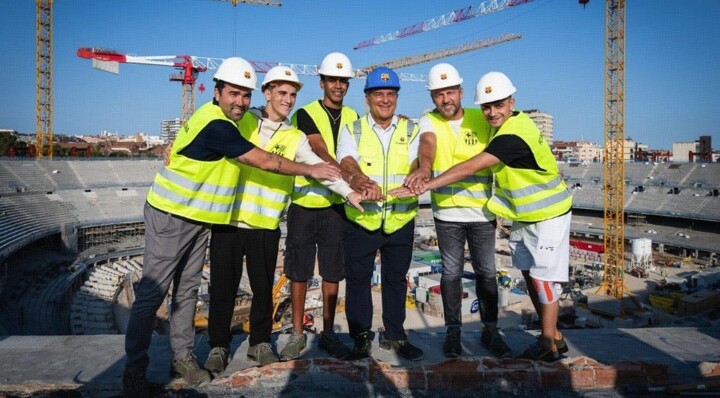
Last October, a few days before the Barcelona General Assembly, Paco Cabezas, head of sports at El Periódico, interviewed Ferran Olivé. Olivé is a key figure on Joan Laporta's board and the financial mastermind behind critical operations such as ISL, Aramark, and Barça Studios. During the interview, the reporter posed a direct question to him: "What role did Goldman Sachs play in awarding the stadium project to Limak?"
Olivé's answer was very clear: "Crucial. Several construction companies submitted bids, and to our surprise, when the bids were opened, the lowest bid came from... As you know, many factors are evaluated in a bid, including technical, economic, and other aspects, but the decisive criterion ultimately became the financial factor, and their bid was the most competitive in this regard. After assessing the situation, Goldman Sachs told us: 'I cannot present a proposal to investors that is 400 million Euros higher than this one. We must accept the best offer, and this offer must also meet all the requirements for executing the project.' It must be considered that Goldman Sachs is responsible to the investors; they brought the investors, and they most want this project to be completed on time and according to requirements. Therefore, their statement at the time, 'we completely agree that the project should be awarded to Limak,' played a decisive role."
Months later, in January 2026, Jordi Costa and Sònia Gelmà interviewed Jorge Alcover, Managing Director of Goldman Sachs' Global Banking and Markets division, on the excellent Catalunya Ràdio program "Tot Costa." When asked if Goldman Sachs had influenced the choice of this controversial construction company, the top Goldman Sachs executive gave a completely different answer: "No. The tender was Barça's business. We were only informed in January 2023 that the chosen company was Limak. Based on the data they provided, we designed the project structure and presented it to investors, nothing more." Faced with such a contradiction, one cannot help but wonder: who is lying, Ferran Olivé or Jorge Alcover?
To understand the current situation, it is necessary to go back in time. On January 9, 2023, Vice President Elena Fort announced the selection of Limak at a press conference. Her statements at the time included some firm commitments: "The project must have a maximum guaranteed price of 900 million Euros, a ceiling that can never be exceeded, and in any case, it could be lower. This is the proposal Limak Construction offered us... Barça's goal is to protect its own interests, prioritizing the completion of the project as quickly and at the lowest cost possible... We will return to Camp Nou by November 29, 2024, to celebrate the club's 125th anniversary, and final completion and delivery must become a reality by June 2026... Limak guarantees time targets and the established price."
Later, President Joan Laporta himself reiterated this claim in an interview with La Vanguardia: "Camp Nou will cost less than expected." He added: "If we cannot return in November 2024, Limak will bear the financial consequences. The most severe penalty is a fine of 1 million Euros for every day of delay. But this will not happen. Their work pace is excellent, and they always finish on time. This is one of their strengths."
As of June 2026, reality is stubbornly persistent. As the club has finally confirmed to several media outlets, there has been a very significant budget deviation. Multiple sources indicate that over 400 million Euros in additional funds will be needed to complete the Camp Nou project. This will force Barça to request new capital injection from Goldman Sachs, which Goldman Sachs is expected to readily accept because its return on investment is already guaranteed. This financial operation must also be approved at the next extraordinary General Assembly.
Of course, the recurring argument will be: the only thing that matters is that Barça will have a cinematic stadium. This will indeed be the case, and the quality of the final materials is another matter. But the core of the problem is not here. The problem is that it has long been an open secret that Limak cannot deliver the project on the agreed date and initial budget. Any expert knows that a project of this magnitude will inevitably lead to delays and cost overruns. However, the board has consistently been firm in its statements, insisting that the project would be completed sooner and at a lower cost.
Time, the irrefutable judge, has dismantled all the reasons, or lies, used to select this Turkish construction company: neither the construction period nor the budget has been met. It is worth remembering that in September 2022, the bidding rules were modified to allow Limak to participate. Surprisingly, Limak submitted the entire project in just three months and ultimately won the tender. What surprised me at the time was that the other construction companies remained silent.
Apart from Jordi Llauradó, who chose to resign, no one on the board seemed to mind that this project used the most expensive financing in the club's history, with bank interest rates between 5% and 7%. Nor did the board deem it necessary to wait for the economic impact of the war in Ukraine and Russia to pass and for the market to stabilize. Worse still, Limak's construction proposal was rated the worst on a technical level by Barcelona's own experts. Despite this, the contract was still awarded to it. Since then, cuts have followed: the 360-degree video scoreboard was canceled, the iconic roof was modified to reduce costs, and other structural adjustments were made, changes that were never transparently explained.
Not to mention, time has confirmed what was suspected from day one: the new Palau Blaugrana was never included in the true financial plan. The promised multi-purpose arena would cost no less than 400 million Euros to build. If the initial 1.5 billion Euros were not enough to complete the stadium, then it is reasonable to ask how the club intends to proceed with the Palau project and its accompanying infrastructure.
First and foremost, the utmost respect must be extended to all professionals involved in this major project. This project is crucial for the club's economic future and for the assets of the city of Barcelona, including executives, architects, engineers, workers, and even the board members themselves, who have invested their time and personal effort.
The core issue lies in responsibility and transparency: nothing that was initially promised has been delivered. Now, they will find excuses in the international geopolitical situation, the procedures of the Barcelona city council, or the final cost of the Santiago Bernabéu. But at least this time, it is time for someone to take responsibility for everything that is happening, admit mistakes, and be held accountable. Yes, because in the end, it is always the same group of people who pay for this feast: the members.