


Gerard Martín was interviewed by Sport, where he discussed his experience playing as a center-back under coach Flick, his interactions with young teammates like Yamal, Rodri's arrival, the rapid transformation of his career, and Barcelona's goals for the current season. Below is the first part of the interview.
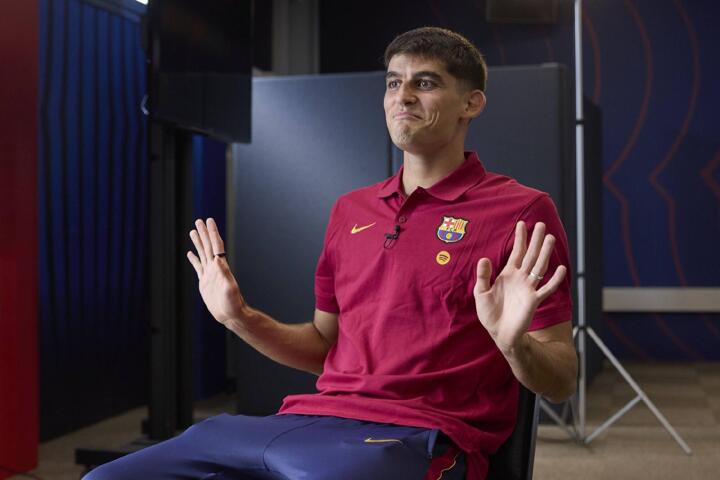
First, Gerard, how have you been lately? How do you feel? How is the new season going? How are you feeling personally?
Very good, very good. We had a very good start, and now we really need a few days of rest, but we will come back with full energy.
From a personal perspective, you played a key role last season, playing a lot of games at center-back, and this season you've essentially continued that trend, remaining in the center-back position. I imagine you must be very happy?
Yes, honestly, I had a great year at center-back last season, and this year I will try to keep it up.
Next up is an unprecedented three-and-a-half-week break. Personally, do you like this break? Because I think it disrupts the rhythm of the game to some extent. You haven't reported to the national team this time, and you mentioned earlier that you'll use this time to recharge, but mainly to train. Do you like this break, or do you think a shorter one would be better?
No, I don't like it, because three weeks without league games, I don't think anyone would like that, after all, it's too long without official matches. We do need some rest these days, but we must continue to train because there are tough games ahead, and we must be prepared.
In addition, Laporta seemed to say at the members' assembly a few days ago: "Oh, just when we were on fire, they cut off our rhythm." Do you have a similar feeling? The whole team had great momentum, and then suddenly hit the brakes.
Yes, there is a bit of that, but we will try to maintain the same competitive state when we return.
Before the interview, we were just talking about how much your life has changed. Because about three or four years ago you were still playing for Cornellà, and then you joined Barcelona B. How does all this feel to you? In just a year to a year and a half, your life has changed dramatically. Psychologically, while not difficult, life changed completely in a few days. How have you dealt with it? What has your experience been like during this period?
The change has been huge indeed. But I consider myself very fortunate to be able to face it with a rather calm and natural mindset. I think it's this mindset that has helped me get to where I am today.
Sports psychology is very popular now; for example, Ferran often talks about it, always mentioning his psychologist Capellán and the support around him. Do you really need this? Do you rely on family? Who do you turn to during drastic changes and difficult times? A psychologist, parents, or someone else?
Yes, family support is obviously essential; at the same time, I also work with a sports psychologist. I think this is very helpful both in good times and bad. Ultimately, in a demanding schedule and high-pressure environment... fortunately, I can handle it well myself, but professional assistance is always a good thing.
What aspects do psychologists usually help you with? Without revealing any private information, of course, but in what specific situations can a psychologist help you adjust better?
When things are going well and everything is smooth, they help me maintain the same focused mindset to prevent complacency and subsequent decline. And when confidence is low, playing time is limited, or I encounter difficulties, they help me build up effort day by day, gradually increasing my confidence and inner security.
In such a short period, you've essentially taken a crash course in the world of Barcelona and its media environment. When you perform exceptionally well for a month or several consecutive games, like when you first started playing center-back, there's a flood of praise, calling you amazing and brilliant. But as soon as you make a mistake, criticism and blame swarm in. I think in this environment, you must build a protective shield around yourself, right?
Well, I try not to pay too much attention to outside opinions, because ultimately I have to focus on my job. But I'm very aware that even a small mistake will immediately make me a target and put me under scrutiny. However, I take all of this in stride because I know very well what I've put in to get here and what I'm doing, and I feel comfortable and at peace with myself.
A few days ago, Lamine mentioned in an interview that you are one of the most underrated players. Do you feel the same way? Do you consider yourself an underrated player? I personally think so, or rather, not getting the recognition you deserve.
From the outside, it might seem a bit underrated, because I might not have much commercial packaging or exposure. But for me, the most important thing is to get recognition from my teammates, family, and head coach, and I focus on doing that.
Speaking of your transition to center-back last season, I want to ask about the specific process when the coach first proposed this idea to you. At that time, Iñigo Martínez had left, which was obviously an important catalyst, but how did Flick explain to you, based on your technical characteristics, why he thought you were suitable for this position? You had played in a three-man defense at Cornellà before, but the tactical requirements at Barcelona are completely different, aren't they?
It was during the Asia tour in Japan, and he told me he wanted to try me at center-back in a match. I played well, and from then on, sometimes in training, I would practice as a center-back. Later, in a certain game, he decided to trust me and let me start at center-back, and it worked well. Since then, I've been fixed in the center-back position.
Did you ever think you would play so well back then? Or did you find that as time went on, playing more and more, you felt increasingly comfortable?
Yes. From the first time I played in that position, I felt quite adapted and comfortable. I knew the key was to understand and adapt to the coach's tactical intentions, and although there were some changes from full-back to center-back, I was very confident because since I felt good, I knew I could perform well there.
People often say that top players have their own benchmarks. In defense, do you have any particular players you watch and try to emulate? Or do you prefer to be yourself and develop your own center-back style? For example, would you specifically watch a defender's games to study their positioning and defensive approach?
Not really. When I watch games, I do pay a little attention to how center-backs handle things, but I don't intentionally try to imitate anyone. On the pitch, I just want to be myself; if I'm going to learn from anyone, it's from my teammates around me.
The nickname "Maldini" started as a joke, but then it stuck. Does anyone still call you that now, or has it gradually faded away?
Oh yes, especially Eric Garcia, he always calls me that. Occasionally others do too, but Eric Garcia calls me that every time he sees me (laughs).
You were promoted from the B team, and now the first team sometimes trains with the B team. Among the young players in the academy – not necessarily center-backs or defenders – has anyone particularly caught your eye, making you think "Wow, this kid has a bright future," and showing great promise to join the first team?
During preseason, we had the chance to see many young players, and I personally really admire Oriol Soldevila and Ebrima (Tonkara). They are very young, but genuinely talented. Although they have a long way to go, I have high hopes for both of them.
Born in 2010, that sounds incredible, right?
Oh my god, really, I feel like an old man (laughs).
There's also another academy youngster, not exactly a new signing but almost like one, Xavi Espart. He made his first-team debut last season and is now playing as an inverted left-back, a position where you might even be able to offer him some guidance, as it's new to him. What do you think of his performance? Have you guided him?
He had an astonishing start. He basically played midfield before, and now he's playing as a full-back in our team. For someone who had never played as an inverted full-back before, he's doing an excellent job. I try my best to give him advice on defensive positioning or high pressing, but on the field, ultimately, he has to play his own game.
He plays very naturally on the field, frequently cutting inside to the attacking midfielder position, which is a very interesting tactic. I think this is also Flick's doing, having the left-back tuck in significantly to create numerical superiority.
Yes. Because he played midfield since he was young, he instinctively moves into central areas, and he has adapted very well.
You just said your life has changed a lot, but the most dramatic change is actually Lamine Yamal. He's gone from an academy youngster to a strong contender for the Ballon d'Or. What's it like to spend time with him every day? Especially defending against him in training, how does it feel? Can you handle him, or is defending against him really a headache?
It's a huge headache, but it benefits me greatly. The higher the demands in training, the more I improve. Although Lamine is very young, some people outside might have a misunderstanding of his true personality, but spending every day with him, I can see that he is far more mature than his peers, and very humble. With the talent he shows now, all the praise he receives is well-deserved.
If he were to win the Ballon d'Or, would it be well-deserved?
Yes, in my opinion, he is currently the best player and fully deserves to win the Ballon d'Or.
AF's PC site is now live! Browse full news, comments, match details and stats on your computer. Visit: www.allfootballapp.com