


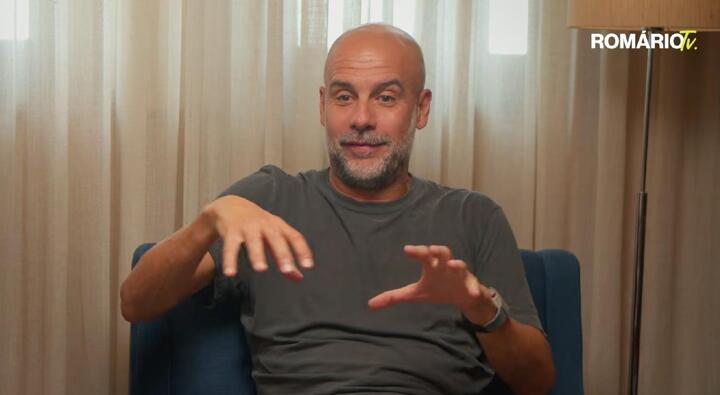
Romário TV aired an exclusive interview with Guardiola. The two former Barcelona teammates reunited in Salvador, Brazil, to reminisce about the "Dream Team" era under Cruyff. Guardiola also discussed the rivalry between Messi and Ronaldo and Ancelotti's Brazil national team, and revealed that he had previously held talks with Italy about coaching their national team. This is the third part of the exclusive interview.
Romário: Among the players you've coached, which ones could become good coaches? You can name one or several.
Guardiola: Many. I think Gundogan would be a good coach, and Busquets too. I knew Xabi Alonso would be a good coach. I think midfielders have a slight advantage because when they play, they have to understand the game more comprehensively. Midfielders have to organize the whole team, and when defending, they also have to cover certain areas. Strikers often think, "I just need to score a goal."
So coaches are also shaped by playing, on the field. My foundation as a coach was laid while I was playing. Later, I took courses to get my license. I learned from the coaches who managed me, from playing with you, and later from coaching Lewandowski. I've worked with different types of forwards. I played with Michael Laudrup, who played as a false nine. You were more of a classic center-forward. That's how my foundation was built. I think only those who love the game and are curious about it have the potential to become coaches.
Romário: You were one of the first coaches to manage Messi. How did you two get along? I'm talking about on the field.
Guardiola: On the field?
Romário: Yes, in training and in matches.
Guardiola: Very well.
Romário: And off the field?
Guardiola: Also very well. I've never seen a player like him. Every three days, he scores three goals and provides three assists, again and again. I've never seen anyone do that so consistently. He does it not only in official matches but also in small-sided games in training. In all those small games we played in training over those four years, I don't remember him losing a single one. He has that drive to win, and I think that's what makes him different.
Everyone has seen Michael Jordan's documentary "The Last Dance," right? When I watch Jordan, I often think of Messi. Yes, there are teammates, and there's camaraderie, but he's there to win, to be the best.
Romário: Is there any player now who has Messi's ability, or could reach his level in 10 years?
Guardiola: I don't see anyone right now. There are many excellent players, but to maintain that level for 15 or 20 years, playing every three days, I don't see it. I probably won't see it.
Maybe someone will emerge in the future; that's how sport is. People say of some records, "No one will ever break this, right?" But eventually they are broken. Usain Bolt's record will also be broken one day. Someone will always come along, but to maintain that level for so many years, and to play with such skill and beauty, is very difficult.
Romário: After you left Barcelona, did you ever think about bringing Messi to another team?
Guardiola: No.
Romário: No?
Guardiola: No, I never thought about it. Messi is a Barcelona player. I'd rather he stayed there.
Romário: What about Ronaldo? What do you think of him as a player?
Guardiola: I think he's also an extremely competitive person. He's single-minded about winning and proving himself. He's a goalscorer, a true goalscorer, who can score with his right foot, his left foot and his head. He's outstanding, truly outstanding.
I think they helped each other a lot to maintain that level for so many years. If Messi hadn't met Ronaldo, and Ronaldo hadn't met Messi, perhaps some of their seasons would have been at a lower level. They were always looking in the rearview mirror, checking what the other was doing. Then they'd think, "I need to be better than him, I need to win more than him." That pushed each of them further.
Romário: This was truly great for football, and we should thank them.
Guardiola: Especially in Spain.
Romário: Right. You've coached in Spain, Germany and England. Which place was the most difficult?
Guardiola: All were good. Each had its easy parts and its difficulties. Nothing comes easily, and nothing is impossible. Every experience was good, with different cultures and languages.
England was a challenge. At the time, they said the style of play brought from Barcelona wouldn't work in England. There, you had to tackle, and so on. But we still did it. Every experience is a challenge. When I took over the Barcelona first team, polls showed only 3% or 4% supported me. I came from the B team, and the first team's results were poor at the time; no one wanted me. I thought, "Great, no one wants me, so this is actually the best situation." That was also a challenge. Then I went to Germany, to a German club, and I had to see how I could adapt.
Then it was England. From an economic, commercial and fan perspective, it's the best league in the world. Some said, "Your style of play, with the goalkeeper and center-backs passing like that, is impossible here." That was another challenge. And after all these challenges, here I am in Salvador, Bahia, chatting with Romário.
Romário: You coached Bayern Munich in the Bundesliga. There are many goals in the Bundesliga now, which wasn't the case before. Do you realize you changed that?
Guardiola: No, I don't think so. I did try to change some things, and I did try to make the team play the way I liked. But to say I changed German football would be too presumptuous. German football is still German football, and Bayern Munich always wins. So there's nothing particularly extraordinary about it.
Romário: You've managed many Brazilian players. Are their ideas and mentality very different from those of the European players you've coached?
Guardiola: I don't agree with lumping all South American players together. Whether they're from Brazil, Argentina, Peru, Bolivia or Colombia, you can't paint players from different places with the same brush. You are Brazilian and have your own ideas. Another Brazilian teammate of yours might have different ideas. And you're all from the same country.
I don't believe in that, and I don't think European players are inherently different from anyone else. Everyone has parents, strengths and weaknesses, and grew up in different environments. That's how we've become who we are today.
Romário: But I'm talking about on the field. South American players and European players are still different on the field, aren't they?
Guardiola: I can tell you that the football Spain plays is closer to South American football than that of any South American team. No one plays better than Spain. Why? Because children are trained this way in all the academies from the age of seven or eight. You can look at any team, and everyone is trying to play this way. You look and ask, "Why can they do this?"
Look at the years since they won the World Cup: U14, U16, U18, U21, finals, semifinals, finals, semifinals. Their basketball teams also reach finals and semifinals, and so does handball, semifinals and finals. They have done better than any other country in understanding the culture of the game and in training methods.
Other parts of the exclusive interview
Guardiola: Messi is what sets me apart from other coaches, great players make great coaches