


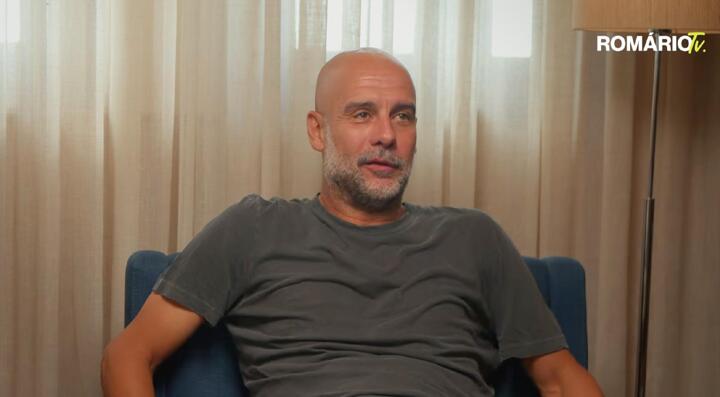
Romário TV aired an exclusive interview with Guardiola. The two former Barcelona teammates reunited in Salvador, Brazil, to reminisce about the "Dream Team" era under Cruyff. Guardiola also discussed the rivalry between Messi and Cristiano Ronaldo and Carlo Ancelotti's tenure with the Brazilian national team, and revealed that he had previously been in talks with Italy about coaching their national team. This is the second part of the exclusive interview.
Romário: Was he (Cruyff) the best coach you ever had?
Guardiola: Yes. I've met many good coaches, truly many. In terms of training methods and preparation, some may have been better than him. But being a coach isn't just about tactics. He had an intuition for how to manage a team: how to prepare after a win, how to prepare after a defeat, how to deal with young players and veterans, and how to handle it when the media praises you too much or too little.
He knew when to confront the media, when to let things cool down, when to engage proactively, and when to relax. When everyone else was going in one direction, he would sometimes go in another, which kept us constantly alert. Nobody did these things better than him. No one, truly.
Romário: Would he protect his players?
Guardiola: Yes, of course. But he would also yell at us, and he did it fiercely.
Romário: He never yelled at you. You were his son, you and Begiristain, both of you. Pep, how did you make the transition from player to coach?
Guardiola: I wanted to be a coach when I was 26.
Romário: Still playing then?
Guardiola: Yes, at 26.
Romário: Why?
Guardiola: I can't really say. I just wanted to at the time. I was already analyzing games and observing how coaches set things up. I would even watch videos of our next opponent and think about how I would arrange things if it were me. The coach would say, "We'll play like this," and I would think, "What if we did this? What if we tried another way?" Back then I would question in my mind what we were preparing to do, and I knew very clearly what I wanted to achieve.
Romário: So coaching makes you happier than playing?
Guardiola: Coaching is tougher; playing is more comfortable. But I enjoyed both periods very much.
Romário: Is there more responsibility as a coach?
Guardiola: It's hard to switch off from football. Players can go play beach volleyball after a match, but coaches think about it 24 hours a day. Don't just say "true." You have no idea what a coach has to think about all day long.
Romário: You started coaching with the Barcelona B team. Did that experience help you?
Guardiola: That was the best decision I made while learning to coach, the best decision. There was one game a week, with no need to play every two or three days. I had time to figure out what we were doing well, and time to train. There were no cameras and no journalists, so I had the time to do what I needed to do. Without that experience, I might not have been able to achieve what I did later.
Romário: How long did you stay there?
Guardiola: One year.
Romário: One year? And then you went straight to the Barcelona first team.
Guardiola: Yes, I went straight to coach the first team.
Romário: You are now one of the greatest coaches in football history. Are you aware of that? What do you think sets you apart from other coaches?
Guardiola: Messi.
Romário: Messi. Did he make you who you are?
Guardiola: Yes. With such excellent players, you become a good coach. What we coaches can and must do is get everyone moving in the same direction, make them understand how you want to play, and ensure that the players you have can play well together. I've had fantastic teams at all three clubs, and the players under me have been amazing, which is why we've won so much.
Romário: Setting aside the number of titles, which period of your coaching career did you enjoy the most?
Guardiola: That's a really difficult question. If you pick one, the others feel slighted. It's like asking me to choose one among all the goalkeepers I've coached.
I have a very deep affection for Barcelona. I was a ball boy there. Barcelona means a lot to me; that's where I started. If things hadn't gone so well at Barcelona, I wouldn't have gone to Germany. I had a particularly good time everywhere I went. I'm not saying this to be polite; I truly had a wonderful time. But Barcelona is truly special.
Romário: What was the most difficult moment in your coaching career?
Guardiola: The most difficult period, and also the biggest challenge, was leaving Barcelona for Germany. I had to learn German, and Bayern Munich had just won the treble under Jupp Heynckes. It was hard to win over the players during that period. It wasn't that they didn't want to listen to me, but the difficulty lay in the fact that they had already won the treble.
When I took over Barcelona, the team had finished 18 points behind Real Madrid the previous season. In such situations, the team is more willing to follow you. It wasn't desperation, but they had played very poorly before, and everyone wanted things to improve.
But what more can a team win after just winning a treble? There's nothing left to win. However, I must say that many Bayern players helped me a great deal, including Philipp Lahm, Toni Kroos, Neuer and Müller.
Romário: Do you think a tactical understanding of the game is the most important thing?
Guardiola: Nowadays, I probably value human relationships more and more. But yes, I became a coach because I love football and tactics. That's how it is.
Romário: Is today's football very different from when we played?
Guardiola: Yes.
Romário: Tactically and technically?
Guardiola: Yes, and physically too, and there's much less space on the field. Today's coaches prepare far more thoroughly than before. Now there's information, data, wide-angle footage and all sorts of other resources, and coaches are much more skilled than they used to be. Today's coaches are extremely skilled.
Romário: If you were just a football lover watching games as a fan, would you rather watch today's matches or matches from our era?
Guardiola: You're a nostalgic romantic. You prefer the past because that was your era. Every era has its good points. Those who watched Pelé and Rivelino play would also say that era was better. All I know is that with today's preparation, diet and training conditions, Pelé would play very well today too.
Romário: Definitely.
Guardiola: Good players are good players in any era. It's always the same. There were good things about football in the past, and there are now too. There were also terrible games in the past, certainly.
Other parts of the interview
Guardiola: I don't know when I'll return to coaching; I need to want it and someone needs to want me
Guardiola: When Italy approached me, I needed a break; a year or two later, I might have accepted