


Romário TV aired an exclusive interview with Guardiola. The two former Barcelona teammates reunited in Salvador, Brazil, and reminisced about the "Dream Team" era under Johan Cruijff. Guardiola also discussed the rivalry between Messi and Cristiano Ronaldo and Ancelotti's Brazil, and revealed that Italy had approached him about coaching the national team. This is the first part of the exclusive interview.
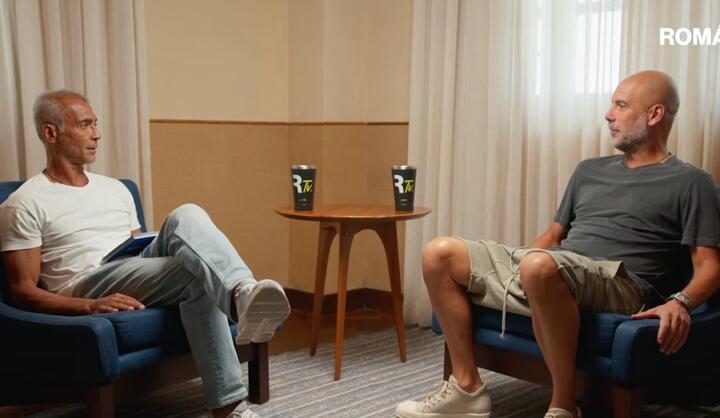
Guardiola: How are you? It feels like we haven't seen each other in ages.
Romário: Many years, really many years.
Guardiola: You haven't changed a bit, you could still play. Me too, it's just the hair... We didn't take good care of you at Barcelona back then. You only stayed a little over a season.
Romário: More or less, more or less.
Guardiola: You left after just over a season. You went wherever you could dance. You were so set on going back to Rio, you just wanted to go home.
Romário: It was better there.
Guardiola: I need to go to Rio too, I have to go.
Romário: Pep, thank you.
Guardiola: You live very comfortably here. How is everyone at home? How are the kids?
Romário: They're good.
Guardiola: Are they all good?
Romário: They've all grown up. I have six children.
Guardiola: My goodness, six. Six that you acknowledge.
Romário: Yes, that detail is important.
Guardiola: Very important. My goodness, Romário. Are you ready? You're a real celebrity. How many people follow you and work for you? Now I understand why you don't have to do any work yourself.
Official Interview
Romário: Everyone, today's guest is very special. When we played together, he gave me many assists. He's one of the best players I've ever had the privilege to play with. Then he became a coach, and one of the greatest coaches in football history. Pep Guardiola, thank you, my friend.
Guardiola: My pleasure. I gave you many assists, I passed all the balls to you. Three in the first game, two in the second, and it continued like that. Then you went back to Rio, to your Rio.
Romário: Pep, how's life treating you now?
Guardiola: Good, everything's good. It's a different life, and it's good. You see, now that I'm resting, I have time to come to Salvador, Bahia. Life is good as long as I'm healthy.
Romário: How long do you think you'll be away from football?
Guardiola: I don't know, I really don't know. For now, I feel good. If one day I feel in my heart that I should go back, and someone is willing to hire me, then I'll go back. If not, I can live my life peacefully. I've done this for so many years and been through so many games.
Romário: You are now a global ambassador for City Football Group, and you're in Brazil in that capacity. What do you usually do?
Guardiola: If the club needs me to show up, to let everyone see what kind of team and club we are, I go. I lend my handsome face to the club.
Romário: You've been a coach for almost 20 years and have won every kind of title. How does it feel looking back now?
Guardiola: It feels good. These years have been very interesting, truly very interesting. It's not easy, football is a very difficult profession. You used to dislike journalists, and now you're conducting interviews yourself, sitting here. You know this profession isn't easy, but I enjoy it.
I've met many amazing people and coached top clubs like Barcelona, Bayern Munich, and Manchester City. The players have been excellent, and most importantly, the clubs have given me their full support, everything they could give. When players join a club, they look at who the coach is. When a coach joins a club, he has to look at who's above him, the club president and the management. In that regard, I've been very lucky. The places I've been have protected me very well.
Romário: Let's go back. In our first game together, you gave me three assists. In many games after that, you also often passed to me. Did I give you a hard time back then?
Guardiola: Romário, let me tell you something. We weren't teammates for long. Sometimes, before the warm-up even started, you'd stand up in the locker room and juggle the ball. I'd see that and think, "Today I need to pass to him a lot, he can win this game for us."
If you were just sitting there before the game, I'd think, "Oh dear, this afternoon is going to be tough." That's how Romário was.
I've always felt that some players have this ability. Later there were Ronaldo and Rivaldo, and I think Messi has it, and Cristiano Ronaldo has it too. They can say, "Today I want to win, and I can win this game. Today I want to win, and I can take it." And they really can. It's just that you don't want to be like that every day.
Romário: Not every day.
Guardiola: Yes, not every day. Am I right? Am I right?
Romário: More or less. Pep, we won La Liga that season, with the last game against Sevilla, and then we went to play the Champions League final against Milan. We lost 4-0. What exactly happened in that game? What's your take? Why did we lose so badly?
Guardiola: I think they played exceptionally well. If we played again, they would still beat us. But I don't think the margin would be that big. They had 10 days to prepare for the final, and we only had 3. Even with more time, they would probably still have won, I just think the score wouldn't have been so lopsided. We fought for months to win the league title. After that, we didn't have time to get back into match sharpness.
Romário: Technically speaking, do you think that Milan team was better than our Barcelona team?
Guardiola: They were very strong, really very strong. We were also strong, but they were simply too strong. Capello's team had their own Italian style of play, which was very difficult to deal with. It was different from Johan Cruijff's style. They were indeed a great team.
Romário: We were called the "Dream Team" then. Was that the best team you ever played for?
Guardiola: That period. You're talking about when I was a player, right?
Romário: Yes.
Guardiola: Yes, it was.
Romário: Our coach back then was excellent, Johan Cruijff. What did you learn from him?
Guardiola: I learned to understand the game, to see the game as a whole. I have my strengths, you have yours, and everyone thinks about their own strengths. But he made us understand why things happened on the field. Many of us later became coaches or sporting directors precisely because he taught us to understand the reasons. Others see a goal and say, "Wow, that was a beautiful goal." But there's a reason why that goal could be scored. I think he made us understand these things.
Other parts of the interview
Guardiola: Messi is what sets me apart from other coaches; great players make good coaches