


It is a good time to play Crystal Palace. That, at least, is the crumb of comfort being nibbled at on Tyneside this week. The rather more uncomfortable truth is that it is also a good time to play Newcastle United.

Just two months in and, unfairly or otherwise, Matthias Jaissle’s future is being measured by some in days and weeks. Not by those inside St James’ Park, nor inside the PIF towers of Riyadh, and not by those on the outside who make allowance for the difficulty of the situation he inherited in August.
Newcastle sold their best players and replaced them with, to be brutally candid, inferior models. It is hard, of course, to upgrade on stars who leave for Barcelona and Arsenal, and what was billed as a brave new era has, in the short term, looked like a backwards stumble.
But Jaissle’s job, as is that of any manager, is to manage what he has, not lament what has been lost. At present, too many square pegs are being hammered into round holes in the hope that they will fit, which they have not. During Saturday’s 1-0 home defeat by Aston Villa, three players started in a position they would not consider their best.
Among them was £51million marquee signing Matias Fernandez-Pardo, who arrived on the promise of reinventing himself as a striker. After three starts without a goal, the 21-year-old was shifted to the wing, albeit the opposite flank to where he spent much of his time at previous club Lille.
Meanwhile, at No 10, in the absence of an actual No 10, midfielders and strikers continue to moonlight.

In the closing stages, centre back Dan Burn was then parachuted in at centre forward. The last time he did that, England were chasing a World Cup semi-final against Argentina.
Jaissle’s ploy was criticised, but the sobering thought for Newcastle, a club who have spent £175m trying to replace Alexander Isak, is that the Hail Mary was their only prayer.
Mitigation for a head coach, however, only extends into so many matches. Another defeat at Selhurst Park – Newcastle have lost three of the last four – and the trauma of summer will be overtaken by the anguish of today. That means more focus on Jaissle and less on the deeper legacy issues as to why his side are struggling.
As opposite number Pierre Sage has found, when there is no easily reachable body of work to use as a shield against scrutiny, judgment can be quick and unforgiving.
Jaissle, at 38 years old and having landed from Saudi Arabia via a successful period with Red Bull Salzburg in Austria, is learning that harsh reality in the harshest of surrounds.
By any reasonable measure, the young German should be afforded time, patience and understanding. He is bright and, increasingly, likeable.
In the Premier League, however, what you deserve you don’t always get. Supporters, especially those amplified by football’s anger-rithm, demand immediate evidence of competence and progress. In other words, results.
Yet the concern when it comes to Jaissle and Newcastle, among those not governed by such outcome-driven emotion, is that the underlying numbers and observations of the eye are more troubling than a far-from-disastrous league position of 11th.

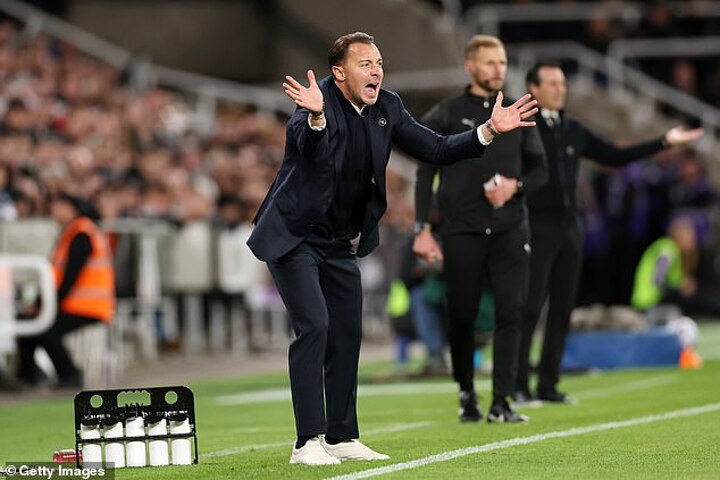
The manager is not blind to that reality, either. He is aware of his side's critical ball losses and unforced errors ranking too highly in the division. ‘Expected Points’, also, has them in the bottom three.
Jaissle has held meetings with his players over the past fortnight, the first in the wake of last week’s 4-1 defeat by Coventry, when issues over the implementation of his ‘vertical football’ philosophy were addressed. His 4-2-3-1 formation has consistently left them exposed in midfield.
Before that, following another 4-1 loss at Leeds last month, Jaissle determined that the poor performance was not a consequence of his tactical approach.
He felt helpless at Elland Road when his players failed to compete for first balls, never mind second, and were bullied into submission.
Working alongside a dozen analysts in a war room at the club’s training ground, he decided it was no time to abandon his strategy when basic application was more so to blame.
But now that effort is present – few could question Newcastle’s commitment against Villa – the spotlight returns to shape, game-plan and preparation. The basics of a manager, if you like.

That has been the source of debate this week. The doubters have likened the coach to Ruben Amorim or Ange Postecoglou, stubbornly wedded to a style that will likely lead to divorce. Jaissle believes otherwise.
Indeed, he noted a recent interview with Barcelona midfielder Rodri, who spoke of the intensity and physicality with which they train, a level replicated on a matchday. That is Jaissle’s vision.
He looks at what countryman Hansi Flick is achieving at Camp Nou, with a 4-2-3-1 set-up, and he wants that energy and incision at Newcastle. His conviction is to be admired, but there is a fine line between sticking to your principles and being held hostage by them.
Jaissle has the kindest fixture in the calendar this weekend. But if the gift horse bites, patience will be the first thing to bolt.