


Portugal's new coach Jorge Jesus was interviewed by Canal 11, discussing his new phase coaching the Portuguese national team. This is the first part of the exclusive interview.
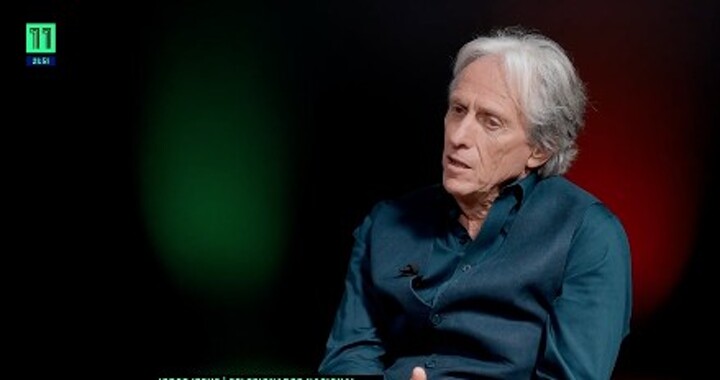
Have you already felt the difference between the daily work of the national team and a club? What was the first thing you did after taking office?
I hope to start this new journey with this interview, and this interview can only take place here, at the home of football, the home of the national team. I am very happy to be here and share with you all the questions you care about.
After the presentation ceremony, my first day was mainly spent familiarizing myself with all aspects here. In the past, I only knew about the external situation here, but I was not familiar with the internal workings. I needed to understand how it operates and the entire competitive structure.
The way I view the national team is actually the same as how I view a club. There is a management structure and administrative department here, as well as a competitive department. Next, I will work with Dr. Lourenço Coelho to establish a system so that everyone understands their reporting relationships. The outcome of a match does not only depend on the performance on the field. Of course, you need organizational skills, strength, and character on the field, but if there isn't a workflow and structure off the field that everyone agrees with, things will become much more difficult.
How have you felt overall these past few days? Has there been any moment that particularly impressed you?
The most impressive was the first day, because I once again communicated face-to-face with many journalists, although "face-to-face" here needs to be in quotation marks. These journalists are all people I am very familiar with in my career. I have been away from Portugal for five or six years. In addition to being full of motivation, I also felt everyone's affection for me, which made me feel very good.
As for the situation on the first day, this is a very large organization, and there are many people I didn't know before. I hope to build connections with them, even if their work doesn't seem to be directly related to mine. Because fundamentally, we are all interconnected. Since arriving here, I come to work every day. I arrive at 8 or 9 in the morning and leave at 5 or 6 in the afternoon. Some people might ask: "No training, what do you do every day?" In fact, there are many things that need to be dealt with, and that's exactly what I'm doing now.
Have you started communicating with the players?
Not yet. I think they should still be on vacation now, so I haven't contacted them yet. When the first squad list is announced, that is, when preparing for the first match on September 24, I hope to have communicated with most of the players within the scope of the preliminary list. I'm not sure if I'll have time to talk to everyone, but I'll gradually do it over time.
How will you contact the players?
I can communicate face-to-face or by phone. If the player is far away, it will be more difficult to meet in person, but as long as the distance allows, I will go to see him personally. We can chat, have a meal, and talk about the national team, that's what I care about most.
There isn't much time left before the first match. My advantage is that among the players participating in this FIFA World Cup, 12 of them have worked with me before, and we have already established a connection. Of course, several years have passed, but they know me, and I know them. Overall, there hasn't been much change. I haven't become a completely different person compared to a few years ago, but there have been some changes.
You mentioned at the presentation ceremony that players must pay a price if they want to win. What exactly does this price refer to?
The so-called price is that they must give up some things they like to do, or things they used to do, it's that simple. There are some things they might want to do, or have been doing, but if these things are not conducive to the team, or do not meet the key factors required for the team to win, they must stop. Therefore, they need to pay such a price.
Whether in the national team or a club, this is the same, and the players' way of thinking is also the same. It's just that some people will be more uncomfortable, and some people won't care as much, but the essence is the same.
So when communicating with players, will you explain this concept of "sacrifice" to them?
I won't use the word "sacrifice." I will tell them that if they want to win and build a strong team, in addition to skill and tactics, they must also have character, unity, and good relationships. The team must understand that it's impossible for everyone to play at the same time, but everyone is important.
Some people will ask: "Are some people more important than others?" This is indeed a fact, and it's the case with every team, it's unavoidable.
What does Portugal need to have to be more competitive in this FIFA World Cup?
This applies not only to Portugal but also to any team, and this is a principle I have always adhered to. The first ability a team must have is to know how to defend, not how to attack, this is the most fundamental.
We are talking about the FIFA World Cup. France against Spain, why did Spain win? Because their defense was better, and they successfully limited the individual abilities of the French players. This is the first principle. Whether in a club or the national team, I will continuously convey this concept to the players.
If you want to win a championship, you must know how to defend. If you don't defend well, you might win some games, but you will never win the championship.
Can we expect to see a Portuguese team with your distinct imprint? Will it be similar to the teams you coached in the past, or different?
It will definitely be different, that's obvious. I have new ideas now, and every coach has their own philosophy. The so-called philosophy is actually an understanding of football. There is no absolutely better or worse formation in football. 4-3-3, 4-4-2, 3-5-2, no coach will say their formation is the best.
In my opinion, football relies on creativity; it's not an exact science. It largely depends on the creativity of the players and the coach. What I want to convey to the players is how the team defends and how it attacks. These two principles seem simple, but they are not easy to implement.
The key is teaching. I don't teach players how to play football, but rather to make them understand the overall philosophy of the team I coach, which is very important.
Which team impressed you the most in this FIFA World Cup? You just mentioned Spain.
In the match between France and Spain, we saw that Spain's defense was excellent, and their tactics were very clear. Indeed, some players performed better in this match, such as Rodri, who was the best player on the field.
I believe that replacing Pedri with Fabián Ruiz was a key adjustment, which made Spain's midfield defense more stable, and at the same time more creative in attack. In my opinion, this determined the course of the match. Based on the same philosophy, my understanding of tactical systems will also be reflected in the future Portuguese team, just like the teams I coached in the past.
However, the players' characteristics will also influence my choices. The overall philosophy is decided by me and shared with the players, but if a certain idea is not suitable for the players' characteristics, I will not insist.
AF's PC site is now live! Browse full news, comments, match details and stats on your computer. Visit: www.allfootballapp.com