


The Spanish Football Federation's Disciplinary Committee announced that Real Madrid's appeal was successful, and the yellow card issued to Ibrahima Konate during the match against Villarreal has been rescinded.
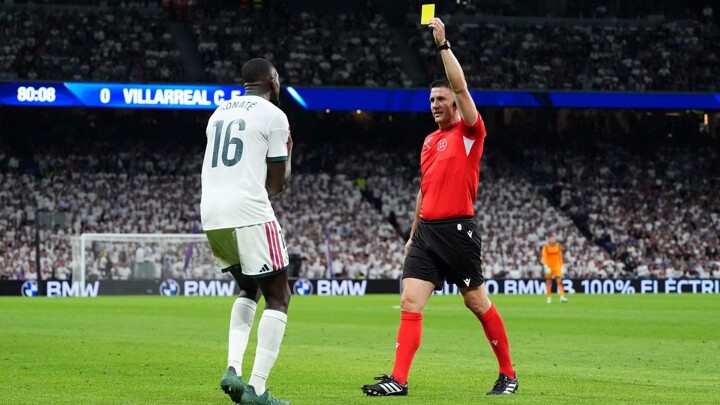
In the 81st minute of the match, Konate was shown a yellow card for an alleged foul on Gerard Moreno. However, video replays showed that Konate made no contact with Moreno, prompting Real Madrid to lodge an appeal.
After reviewing the incident, the Spanish Football Federation's Disciplinary Committee determined that a clear factual error had occurred and decided to overturn the yellow card.
Official statement from the Spanish Football Federation's Disciplinary Committee:
In the referee's report for the LaLiga Matchday 8 fixture between Real Madrid Club de Fútbol and Villarreal Club de Fútbol on October 10, 2026, the following was recorded:
"In the 81st minute, player (16) Ibrahima Konate was shown a yellow card for the following reason: bringing down an opponent while challenging for the ball, thereby stopping their advance and curtailing a promising attack."
Regarding Real Madrid Club de Fútbol's appeal of the caution issued to player Ibrahima Konate, this Disciplinary Committee believes the following:
First, the appealing club contends in its written submission that the aforementioned player did not make contact with the opposing player and requests the annulment of the caution.
Second, this Disciplinary Committee consistently holds that to establish a clear factual error in the referee's report, evidence must be submitted that proves, beyond reasonable doubt and in an unequivocal manner, that the facts recorded in the report did not occur or that the record is clearly erroneous.
This consistent standard is based on the following:
(1) First, Article 155, paragraph one, of the Regulations of the Royal Spanish Football Federation states: "The referee is the sole and ultimate technical and sporting authority responsible for officiating the match." The same provision also states that the referee's duties include "cautioning or sending off all players who are found to be acting improperly or inappropriately, as well as coaches, assistants, and other personnel subject to the relevant regulations, depending on the severity of the offense" (Article 156, paragraph 2, section e); and "drafting the match report faithfully, concisely, clearly, objectively, and completely, and, when deemed appropriate, supplementary reports, and submitting these reports and supplementary reports to the competent bodies and authorities in the quickest possible manner and procedure" (Article 156, section b).
Regarding the evidentiary value of the aforementioned report, Article 27 of the Disciplinary Regulations of the Royal Spanish Football Federation stipulates that the referee's report "is an indispensable written piece of evidence within the complete system of evidence for proving violations of the rules of the game and sporting norms" (paragraph 1). This article also states: "In determining disciplinary infringements, the referee's decisions on facts related to the match are final and are presumed to be true, except in cases of clear factual error" (paragraph 3).
Therefore, the referee's report enjoys a rebuttable presumption of truth; this presumption can be overturned when a clear factual error can be proven.
Decision announced by the Disciplinary Committee of the Royal Spanish Football Federation on October 14, 2026.
(2) Second, relevant rulings by the disciplinary bodies of the Royal Spanish Football Federation and the Sports Administrative Tribunal support the above view. These bodies have clearly established in numerous decisions that submitted evidence must decisively prove a clear error by the referee.
In this regard, reference can be made to the decision issued by the Sports Administrative Tribunal on September 29, 2017 (file number 302/2017). This decision states: "When Article 27 of the Disciplinary Regulations of the Royal Spanish Football Federation stipulates that the referee's decisions on facts related to the match 'are final and are presumed to be true, except in cases of clear factual error,' it means that the principle of irrevocability ('finality') enjoyed by the referee's decision, in order to maintain legal certainty, especially the stability of the rules of the game, can be limited in the presence of 'clear factual error.' A 'clear factual error' is a form or subtype of 'factual error'; as the Constitutional Court has pointed out when referring to this term in procedural law (see Article 214, paragraph 3 of the Civil Procedure Law and Article 267, paragraph 3 of the Organic Law of the Judiciary), it should be a clear, obvious error, and not dependent on any opinion, evaluation, interpretation, or legal classification that might be made."
(3) Finally, it follows from the above that to challenge the veracity of the decisions recorded in the referee's report, the appellant must provide the disciplinary body with appropriate and sufficient evidence to prove the existence of a "clear factual error."
In this regard, the Sports Administrative Tribunal has also consistently recognized that video evidence can serve as an effective means of proof to overturn the contents of the referee's report. At the same time, the Competition Committee is obliged to view and evaluate the relevant video to verify whether its content aligns with the appellant's statements.
Ultimately, only proof of a clear factual error can overturn the presumption of truth enjoyed by the referee's report and invalidate the challenged caution.
Third, after reviewing the arguments presented by Real Madrid Club de Fútbol and the video evidence submitted in support of its claims, this Committee believes that the relevant arguments should be upheld, as there is a clear factual error in the description of the facts underlying the challenged caution.
In fact, upon viewing the relevant footage of the disputed action, it can be confirmed that the cautioned player did not make contact with the opposing player, a situation that contradicts the factual premise on which the referee's decision was based.
Therefore, the relevant footage is sufficiently clear and objective to prove that the penalized action did not occur in the manner recorded in the referee's report.
It should be noted that the presumption of truth for the referee's report recognized by the Disciplinary Regulations of the Royal Spanish Football Federation is not absolute; it allows for rebuttal when sufficient evidence is submitted to prove the existence of a clear factual error.
This case falls under such circumstances: the video evidence is sufficient to overturn the referee's narration of the relevant facts, and this fact has a substantial impact on the determination of the penalized action.
Therefore, the arguments put forward by Real Madrid Club de Fútbol should be upheld, and no disciplinary consequences shall arise from the challenged caution due to the proven clear factual error in the determination of the facts when the caution was issued.
Based on the above reasons, this Disciplinary Committee makes the following decision:
To uphold the arguments presented by Real Madrid Club de Fútbol; therefore, no disciplinary consequences shall arise from the caution issued to player Ibrahima Konate.
AF's PC site is now live! Browse full news, comments, match details and stats on your computer. Visit: www.allfootballapp.com