


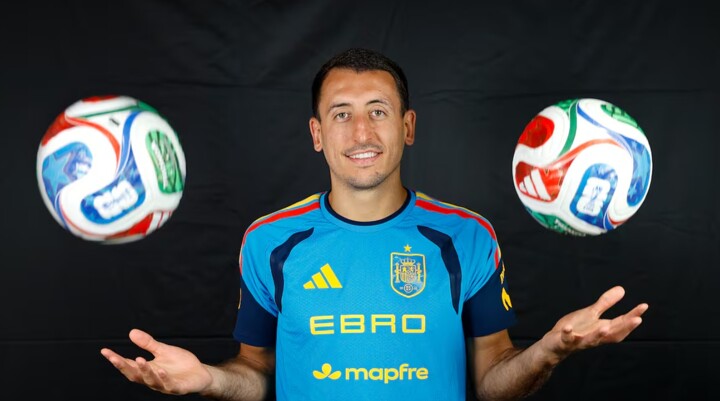
With only a few hours left until the Spanish national team's first FIFA World Cup match, national team forward Oyarzabal gave an exclusive interview to AS.
Q: You are now the undisputed starting No. 9 for the national team. Previously, you were more of a super-sub. Do you feel recognized by the outside world now?
A: That's normal. When you consistently start and get more playing time, the outside world naturally talks about you more. But I don't care about external evaluations and recognition. I know who should advise and guide me—the coaching staff, the staff, my teammates. They are the people I value, and I have no complaints about that.
Q: The decisive goal in the European Championship was a key turning point. Did that change you? Do you feel it was a watershed moment for your public image?
A: The outside perception might have changed because of it, but I haven't changed at all. I've always been a calm person, and no matter what happens, that won't change.
Q: You weren't originally a center forward, and your transition to a No. 9 has been a long adaptation process. When did you realize you could handle the center forward position? Have you discussed this with Coach Luis? You played this position under him in the U21 national team before.
A: Three years ago at the club, I started playing more as a center forward; in the U21 European Championship and Olympic Games, I played almost entirely in this position, and I've always had opportunities to play there at the national team level. But at Real Sociedad, I've played on the wing for many years. Perhaps that knee injury changed my physical condition, and a combination of factors ultimately led to this position change.
Q: From a psychological and tactical understanding perspective, what was your journey like in making this position switch?
A: When I first transitioned, I felt a bit uncomfortable, but after continuous communication with the coach and teammates, I gradually understood the team's requirements for the center forward position. Since the transition, I've been adjusting and improving myself. The core is to understand the team's needs and proactively create opportunities for teammates, without waiting for others to ask.
Q: After a major knee injury, how much have you changed compared to before the injury?
A: The change is undeniable, and the injury also made me reflect a lot, leading to shifts in my mindset and thoughts.
Q: You once said that this injury made you understand yourself better.
A: I was very lucky that during my recovery, I didn't worry about whether I could return to the field or regain my peak form. Not overthinking actually helped me a lot. During that time, I was able to do many things I normally didn't have time for: spending weekends with my wife and friends, planning trips that were hard to achieve as a player. That summer meant a lot to me and healed me significantly.
Q: You are the only one in the national team without an agent. Do you consider yourself an unconventional player?
A: I can't say if I'm different or not (smiles gently). I just do my own thing and I'm very content with that. There's always room for improvement in life, and I have a calm mindset, diligently doing my part. As for being unconventional, I don't dwell on it too much.
Q: You have a calm personality and serve as both captain of Real Sociedad and one of the captains of the Spanish national team. What kind of leader do you consider yourself to be?
A: I've always been quiet, introverted, and humble with people.
Q: I heard you were very mischievous and boisterous as a child.
A: That's true when I was a child (laughs heartily), I couldn't sit still for a moment back then. As I grew up, it's not that I'm unsociable, but my personality isn't very outgoing, so it's hard for me to quickly mingle with a large group of people. Football has changed me quite a bit. I believe there's more than one type of leadership. You don't have to shout loudly; leading by example and without forceful pressure can also guide a team, and every method is equally effective.
Q: You've taken over the center forward role from Morata, and even with impressive stats, he often faces external criticism. Does the pressure of wearing the national team's No. 9 jersey feel heavy?
A: This varies from person to person, depending on their personality. Morata's ability is unquestionable; he has achieved countless honors and delivered impressive results. Many people criticize him, and I don't know if it's out of jealousy or simply looking for something to talk about. We are public figures, destined to be discussed, but Morata knows that everyone in the team highly respects and likes him. The weight of the pressure from the jersey depends entirely on how you perceive external opinions.
Q: You are now the team's attacking core, having scored in 6 consecutive games. If you score against Cape Verde, you'll break a record. Does this motivate you, or do you deliberately try not to think about it?
A: I haven't considered the record at all. As long as the team performs well overall, I'd be perfectly happy even if I don't score a single goal throughout the tournament. This is what I've always believed, and it should be this way. It's great if I can score, it helps the team; but if I had to choose, and a goal doesn't bring a team victory, I'd rather give up my personal goal.
Q: Your calm personality is perfectly illustrated when taking penalties; you were composed when walking up to the penalty spot in the shootout against Switzerland. How do you train and adjust your mindset for penalty moments?
A: Whenever I have the chance outside of training, I practice penalties. I dedicate two or three days each week to repeatedly practice, maintaining confidence when shooting, and planning multiple shooting options in advance. At the same time, I also observe the opposing goalkeeper's habits and make judgments on the spot. When stepping up to the penalty spot, it's crucial to stay calm; whether you score or not, confidence is the prerequisite.
Q: Borja Iglesias calms himself by making hand-brewed coffee. What do you do to relieve stress and detach from thoughts of the game?
A: My method is simple: talk as much as possible with my wife, children, and family. The time difference creates many obstacles, but knowing that my family is doing well and being able to temporarily escape the confined training environment completely relaxes me.
Q: The outside world clearly senses that everyone in the locker room believes the team has the ability to win the championship. Is that really the case within the team?
A: Yes, we must believe we can win. The football field is unpredictable, but as long as you believe you can do it, you're one step closer to success. In the last European Championship, our whole team was confident, believing we could compete with any opponent, and we ultimately proved ourselves with our results. We won't be blindly arrogant; we'll stay grounded but always full of confidence.
Q: The outside world generally regards Spain as a favorite to win the championship. Does this high expectation bring a burden?
A: No, it doesn't. It doesn't matter what the outside world says or discusses; our whole team is calm and focused on ourselves. The team atmosphere is excellent, and we've gotten along very well during these weeks of training.
Q: Returning to the topic of the center forward position, the team has wingers like Nico, Lamine Yamal, and also Ferran, Baena, and other wing players with distinctly different styles. Do their characteristics influence your on-field choices?
A: Of course. Good players know how to adapt flexibly to the situation on the field. At Real Sociedad, my teammates are completely different from those in the national team. I need to adjust my runs and choose the most suitable position based on the technical characteristics of my teammates around me.
Q: Some say you've been extremely competitive since childhood.
A: That's right, and it still is, just not as intensely competitive as when I was a child. Competitiveness is ingrained in me. I often say, I'm not a pure winner, but I am a natural competitor. I enjoy winning in all competitions, it's just that as I've grown older, my mindset has become a bit calmer (smiles), but the desire to win has never disappeared.
Q: You don't like the spotlight and are very comfortable at Real Sociedad, but you've also said that the future is unpredictable. Have you ever considered leaving Real Sociedad and seriously thought about a transfer?
A: As you said, anything is possible in life and in a career. But I've stated countless times that at Real Sociedad, I feel valued and loved, and that sense of belonging is hard to find at other clubs. My family and close friends live twenty or thirty minutes away from home, and this stability is crucial to me. What will happen in the future is unknown, but my heart always leans towards Real Sociedad.
Q: Without an agent to shield you from outside distractions, how do you block out negative public opinion outside the field?
A: The best way is to ignore it. When I first joined the national team, the noise from outside might have disrupted my rhythm and daily routine, but after many years in professional football, I've already seen through the nature of public opinion, and ignoring it is the best way to deal with it.
Q: What details within the team make you particularly optimistic about this FIFA World Cup?
A: Our team is exceptionally talented, everyone is full of fighting spirit, and the team atmosphere is pure and healthy, which is the most crucial point. A 50-day training camp can easily lead to fatigue and depression, but our team atmosphere is great; you can cry when you're sad, laugh when you're happy, and no matter what problem arises, you can talk to any teammate and rely on them. This is our current state.