

According to L'Équipe, since joining Barcelona this summer, the Spain national team captain has experienced a completely new style of play under Flick. Compared to his time at Manchester City, Barcelona's play is faster-paced, and the tactical philosophies of the two teams differ significantly.
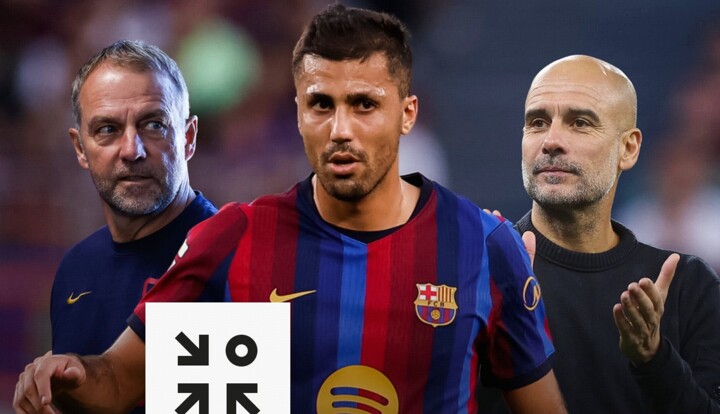
This summer, after seven seasons at Manchester City, Rodri left the Premier League for Barcelona. He had anticipated a respite from the relentless pace of the Premier League, hoping to escape constant high-intensity demands and the perpetual cycle of attacking and defending. In short, he wanted to leave a pitch that was always under pressure.
Evidently, the 2024 Ballon d'Or winner was only partly correct.
Rodri told Spanish radio station COPE: "I thought coming to Barcelona would be all about rondos and possession. But after just four days, I started thinking, 'Where have I come to?' They arranged very intense physical training and gym sessions, which surprised me."
This description stands in stark contrast to Barcelona's traditional image: ground passing, intricate play, and technique prioritized over physical confrontation.
But Rodri did not join an ordinary Barcelona. He arrived at a team coached by Hans-Flick. The German coach led Bayern Munich to the Champions League title in 2020, with that Bayern side featuring one of Europe's most aggressive attacking systems.
Since taking charge of Barcelona in 2024, the former assistant coach to Germany national team manager Joachim Löw has remained true to his tactical principles. Rodri's previous comments mainly concerned his training experiences, and Barcelona's overall match performance also confirms this. When asked about the differences between his current coach and Guardiola, whom he worked with at Manchester City, the Spain national team captain stated bluntly: "Flick and Guardiola are completely different."
Flick's forwards make more than twice as many runs in behind the defense as Manchester City's.
Less patience, a more advanced overall formation, and a more aggressive defensive line. Flick made his tactical direction clear from the moment he took over. The former Germany national team coach does not intend to abandon the pursuit of possession, but he emphasized: "I also want the players to attack the goal more directly."
Unlike some coaches who talk tactics without necessarily delivering on the pitch, Flick's tactical philosophy is highly consistent with the team's performance. Last season, with similar possession times, Barcelona's attacking players made more than twice as many deep runs as Manchester City's.
Furthermore, Barcelona players' deep runs are not just about pushing forward into the opponent's half; more importantly, they aim to complete attacks quickly. If we only count runs made from behind the defensive line within 10 seconds before a goal, the gap between Manchester City and Barcelona this season is nearly 1 to 3.
Raphinha is the best example. This season, the Brazilian winger has been deployed in a center-forward role, constantly sprinting forward with barely any time to rest. New summer signings Anthony Gordon and Adeyemi share similar characteristics; both excel at using their pace on the left wing to challenge opposing defenses and constantly attack space behind the line.
Faced with such relentless waves of attacks, opposing defenses are often overwhelmed and eventually succumb to the attacking tide.
Off the ball, Rodri's involvement in the team's pressing has also increased by 75% compared to last season at Manchester City, under the premise of similar possession times.
Overall, Rodri's feelings are understandable: the Barcelona he plays for now indeed plays more directly and advances attacks more quickly. However, does this mean the team's intensity is higher?
Faster pace, yet shorter running distance
If game intensity is measured by a player's total running volume, the answer is no.
Compared to last season, Rodri's distance covered per 90 minutes this season has decreased from 11.4 km to 10.7 km; his number of sprints has reduced, and high-intensity running distance has also dropped from 707 meters to 589 meters.
However, these statistics must be analyzed in the context of the specific match environment. A simple comparison of raw data does not fully reflect the intensity of both teams' play.
AF's PC site is now live! Browse full news, comments, match details and stats on your computer. Visit: www.allfootballapp.com