


Argentina will face Costa Rica in a friendly match. Before the match, Argentina's coach Scaloni attended a press conference and answered questions from the media. In the third part of the press conference, Scaloni spoke about the possibility of Messi joining the coaching staff in the future, his conversations with Simeone, and Argentina's goals for the new cycle and plans for the 2030 World Cup.
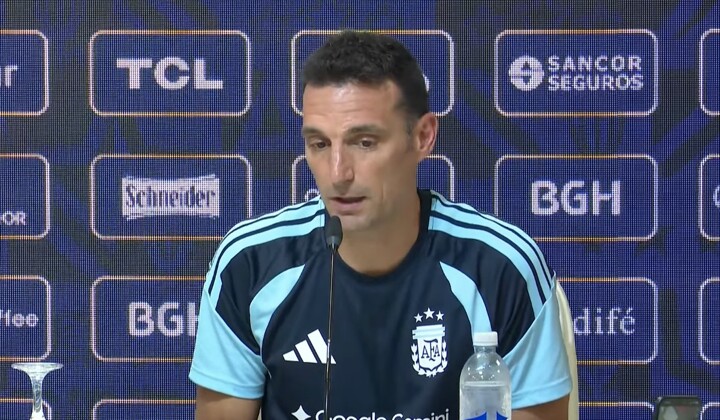
Reporter: Lionel, with this new cycle you are embarking on, looking ahead to 2030, and with Messi having retired from the national team, is there any possibility that he could be a member of your coaching staff at that World Cup?
Scaloni: I think he will continue to play until... No, but... Do you mean as a player or as a...
Reporter: No, coaching staff...
Scaloni: No, he will continue to play. He will continue to play after 2030. You mean he has said he will no longer play for the national team, but as a footballer, I hope he can keep playing until he can't anymore. If he wants to come here, there's no problem at all. You see Walter Samuel isn't here now, so let him come.
Reporter: Hello, Lionel, first I want to ask you, what demands have you set for yourself for this second coaching cycle? Second, last week, before and after the match, you repeatedly emphasized not to put responsibility and pressure on the young lads. But then again, the Argentina jersey definitely carries a lot of weight... How do you internally work on this so that they don't put this pressure on themselves? Is there anything specific you can share about how you do it?
Scaloni: I haven't set any specific goals for myself. Our idea is to continue to be competitive, that's what football is all about. As I told them a few days ago, we played a good game, and I think we lost the game due to two set-piece defensive errors, but we can't completely dismiss the entire game because of that.
So, as long as we continue to do what we have been doing on the field for the past few years – controlling the game and giving our best – I think that is the goal: to find players who are still passionate about playing for the national team. This is our number one goal, and I think this will continue to be the case.
As for young players, I think it's very natural and normal; you can't ask or expect such a young player to help you win a game. Even if he performs very well at his club, the national team has a different environment and different realities. There are many great players here, and these great players who have been here for a long time should guide these young lads.
But that doesn't stop us from playing them. We will look for the right moment, just like we did with Soulé the other day. We felt that halftime was the right time, but then the opponent scored two goals quickly after he came on, so perhaps he wasn't able to perform at his best. But that's what we are striving for – gradually integrating young players and trying to give them playing time at the most ideal moment.
Sometimes you plan it that way, but the results are not always satisfactory. However, we always try to make that moment a positive one for them, and most importantly, to leave them with good memories of their first few national team matches.
Reporter: Hello, Lionel, yesterday you hosted Simeone; he visited the training ground. I wonder if you had a chance to talk to him. You both have something in common: both have long-term coaching plans. He has been coaching Atletico Madrid for over a decade, and you have also extended your contract. Do you think this is the key to success, having a long-term cycle?
Scaloni: Obviously, the longer the time given to any cycle, the better. Fortunately, like him, I have received that kind of support, allowing me to withstand difficult times... He has had fewer difficult times, because honestly, he has won many championships and has been very successful from the beginning. What he is doing now and what he has done in the past is simply fantastic. We have a very good relationship with him and his entire coaching staff. I have bothered him in Madrid, and he has also come here... Of course, he didn't come to bother me; I was the one bothering him.
But it was really great, very happy that he could come and talk about football, because ultimately, he is a coach who speaks the same football language as us. We communicate in the same way and understand each other very well. And although he coaches a club and I coach the national team, ultimately we both want the best for each other, and he also wants the best for the Argentina national team.
We talked about football, about many things. He also has Argentinian players at his club, and sitting down with someone like that to talk about football is ultimately an enjoyment. So it was a fantastic visit, and I hope he continues to come, or I'll go visit him again.
Reporter: Hello, Lionel, speaking of cycles, with your confirmation as head coach, this is a new phase. In the first phase, many new players emerged, some of whom were even unfamiliar to the Argentina national team; in the second phase, the team found its footing, winning the World Cup and two consecutive Copa América titles. What will the next phase be like? Will it be back to square one, rediscovering players, or building on the existing foundation, finding and consolidating the current squad? How do you envision it from now until 2030?
Scaloni: This is somewhat similar to what I just said. Unlike before or the first cycle, we now perhaps have a more solid core. What we need to do is fill the gaps that we believe will be left in the team as several great players leave – they are irreplaceable.
We can bring in anyone, but no one can completely replace them, because they are the top players in the world. However, we do have to try to fill the gaps they leave... with young lads we believe can stay here for a long time.
This is roughly the challenge we face. To reach that highest level – I don't know how high it will be, but it will definitely be a very high level – we must keep trying, we must keep experimenting, giving these young lads opportunities. When we determine that a certain player is the right fit, perhaps there will be less experimentation, and the call-up list will be more streamlined. Then you yourselves will start to notice that the team's core is no longer 12 to 14 players, but 20 players, which is similar to the past situation.
That's roughly our idea, and we are at a point where we must do this. Personally, I think although we lost the other day, we played very well, and this shouldn't obscure our path forward. No one likes to lose, but I think in this situation, the result is secondary, even though losing frustrates us, we are pursuing something else, and to be honest, we are very satisfied.
Reporter: Lionel, although there's still a long time until the next FIFA international break, I want to ask you, as a coaching staff, besides the squad that has already been assembled in recent call-ups, do you already have specific individuals in mind to continue to enrich this generational change?
Scaloni: Yes, we do have some lads, as everyone knows, we couldn't bring them in for this call-up, or rather, we didn't want to bring them in, because they are playing matches, and we don't want to cause an impact, especially when there are matches during the call-up period... And since we are not playing any particularly important matches right now, it wouldn't be appropriate to do so, which is also logical.
These young lads could all come here in the future, and we really wanted to call them up this time. Plus, those injured players... I think we already have 24 players now. If we include these players, plus the injured and suspended players, we have a pretty good list of players to choose from.
After about ten call-ups, we will start to form the configuration we have always had since we arrived here: a squad of 20 players, basically the same group every time. Until then, we will continue to try.