


According to the British media outlet ABC, all members of the Spanish national team underwent doping tests before the World Cup.
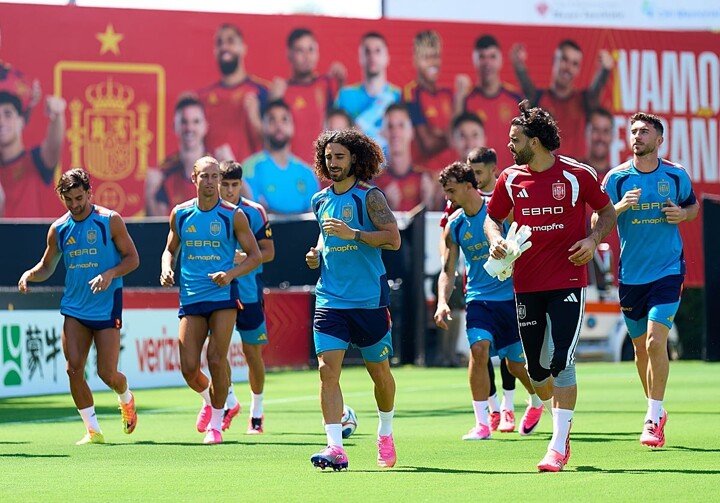
The initial hours after the Spanish team arrived in Chattanooga, their first permanent residence for the group stage, provided some reassurance for Spanish fans. Chattanooga is located in Tennessee, a southern US state, with a population of 194,000, and has a history of cotton plantations and the American Civil War.
A fierce tackle by Gavi gave the Spanish coaching staff a scare as Rodri lay on the pitch in apparent pain. Lamine Yamal, on the other hand, created a buzz locally, appearing on the front page of the local newspaper for kindly signing autographs for young fans. FIFA also provided the Spanish team with a briefing on refereeing rules, including a significant change: fouls off the ball could now result in a penalty kick. Baena expressed the team's displeasure at losing their number one FIFA world ranking.
Just hours after arriving in the US, the Spanish team already had their first World Cup outing: they will travel to Puebla to face Peru, with the match taking place at 4 AM Spanish time, which is 10 AM Beijing time (CEST). Luis de la Fuente and player Yeremy Pino will also attend the press conference. For what is expected to be a challenging World Cup, the Spanish team will soon experience their first international journey.
In a matter unseen by the outside world, all Spanish national team players share a commonality, one that perhaps even they themselves are not fully aware of. All 26 players called up by Luis de la Fuente for this World Cup have undergone at least one doping test in the past three months. This week, the results are awaited to confirm they can participate without any concerns.
Spanish team members may have unknowingly completed a process established by the new Spanish anti-doping management. The official name of the agency is the Spanish National Anti-Doping Committee for Sport. All Spanish athletes participating in any international competition, whether continental or world championships, must complete a doping test within the last three months before the competition. The test results are expected next week, and if no notification is received, it means all results are negative.
Whether it's football stars like Lamine Yamal, Rodri, or Nico Williams, or athletes in niche sports who rarely make headlines and whose participation is unknown to the outside world, the rules are the same.
Last Tuesday morning, 12 Spanish national team players underwent out-of-competition doping tests by the Spanish Anti-Doping Committee during their training camp at Las Rozas Football City.
In this way, the Spanish National Anti-Doping Committee for Sport completed the loop. All players have undergone at least one out-of-competition test in the past year and have also passed another doping test within the last three months before the World Cup.
UEFA warned last year that any team participating in its competitions requires players to undergo at least one unannounced test annually. The Spanish National Anti-Doping Committee for Sport considers this an ideal practice. This means that Spanish athletes sent to international competitions appear to be free of doping suspicions.
The Spanish National Anti-Doping Committee for Sport stated: "This is not to undermine the credibility of our sport; quite the opposite."
Tests conducted within Spain are urine tests. These are related to the screening of target substances corresponding to the historical context of each sport. Urine tests primarily track steroids, anabolic substances, and similar strength-enhancing substances; blood tests are used to observe blood indicators and blood flow, and are more common in endurance sports.
Spanish national footballers did not experience uncomfortable scenarios like being woken up early in the morning or having to provide a urine sample with testing personnel present. Typically, clubs or national teams indicate training times in the ADAMS whereabouts system, and tests are usually scheduled during these periods.
However, national anti-doping agencies have the right to conduct doping tests between 5 AM and 11 PM on any day of the year. During this period, athletes must undergo mandatory testing; refusal to test is legally equivalent to a positive result.
Last year, before the 2025 UEFA Nations League finals in Germany, testers from the Spanish National Anti-Doping Committee for Sport woke up Spanish team players at Las Rozas at 7 AM.
Last Saturday afternoon, four Spanish team players at their hotel in Chattanooga were requested by FIFA to undergo unannounced tests. FIFA, as the highest governing body in football, also conducts regular monitoring of teams before competitions to prevent unforeseen circumstances. According to sources familiar with the situation, FIFA aims to keep a close watch on strong teams through unannounced tests to assess potential future issues.
According to sources from the Spanish National Anti-Doping Committee for Sport, football is one of the sports with the most doping tests throughout the year, and proportionally, also one of the sports with the fewest positive results.
The most recent significant positive case in football was Athletic Bilbao defender Yeray Álvarez. His test showed an adverse analytical finding for canrenone, a prohibited substance that is a new product with masking effects, for which he did not have a Therapeutic Use Exemption. The player attributed the positive result to mistakenly taking medication to inhibit hair loss. UEFA suspended him for 10 months, and the ban officially ended on April 2, 2026.