


According to The Athletic, a giant tactical analysis screen at Real Madrid's training ground has attracted considerable attention in recent weeks.
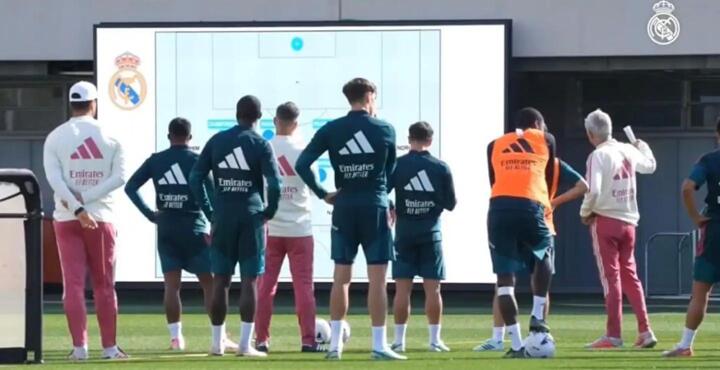
The sheer size of the equipment is hard to ignore, and it gives head coach José Mourinho another way to communicate his demands to the players precisely.
In the image above, broadcast by Real Madrid TV, Mourinho stands in front of the screen holding a piece of paper and addresses a group of players, who look like attentive students in a classroom. Beside him are members of the coaching staff, including assistant coach João Tralhão and technical coaches Pedro Machado and Khedira.
The screen was installed at Mourinho's request. He used a similar system during his time at Roma. In Madrid, it has become a regular part of his daily work rather than an occasional prop for presentations.
The screen serves several purposes in tactical work. It can be used to analyze opponents, but sources within the coaching staff, who requested anonymity because they were not authorized to speak publicly, say its main focus is the team's own movements, both with and without the ball, and preparing players for the situations they may face in a match.
Before certain training sessions, Mourinho uses the screen to explain his requirements to the team, moving markers bearing players' names to demonstrate positioning. His explanations are usually brief.
The system can also replay training and match footage to pinpoint problems. Sources at Valdebebas, Real Madrid's training base, gave an example: during a high press, a full-back fails to close down space. Mourinho can use the footage to show where the player should have been and how the movement could have been executed better. Markers can also be moved to other positions to demonstrate alternative options. The system also includes a scoreboard and timer to control the pace of training drills.
In these sessions, Mourinho is sometimes assisted by members of the coaching staff and sometimes by personnel from the analysis department, which is headed by Roberto Merela.
Those who work with the screen describe it as a pragmatic innovation. They say Real Madrid's coaching staff are always looking for new ways to improve their work and help players understand the coach's demands.
However, Mourinho is not the first coach to use this type of technology. Sources at Valdebebas pointed to Julian Nagelsmann, the Germany coach and former Bayern Munich coach, who they said used a similar system at Hoffenheim in 2018. Last season, Paris Saint-Germain coach Luis Enrique was also seen using large tactical screens in training.
The goal is simple: to convey information to players as intuitively and clearly as possible. In Mourinho's view, however, it is the players who ultimately decide matches.
"We train both defensive and offensive organization," Mourinho said at a press conference before Real Madrid's 4-0 win over Málaga on August 30, when discussing his training sessions. "For example, today we spent 45 minutes on offensive organization. Of course, we also work on the team's structure and tactical movements.
"But when the real challenge comes, it is the players who win the games. You have to give them space to be creative and to make decisions, without losing the concept of overall organization."
Since Mourinho took over this summer, his staff have been working long hours, sometimes up to 12 hours a day. Mourinho himself often sleeps at the training ground, as he also did in his previous job at Benfica. Some of those who came with him to Madrid have left their families in Portugal and devote most of their time to work.
Those who observe this work closely say Mourinho is demanding and wants to keep tight control, but his training sessions are far from rigid. He does not impose his methods on the team. Instead, he adapts his approach to suit the established stars in the squad, and sources say player feedback has been quite positive.
Mourinho's tactical approach in matches is less conservative than during his first spell at Real Madrid (2010-13), and his press conferences are also more expansive. The 63-year-old can be remarkably verbose in some answers, occasionally speaking for so long that the club's press officer has to intervene.
The Portuguese coach was expected to bring a hard-line approach to the Bernabéu, but all indications suggest otherwise.
The screen is another way for Mourinho to communicate his ideas and bring players closer to the details of his work.
Its purpose is not to restrict players' individual qualities, but to give them a collective structure within which those qualities can flourish.
Two months ago, Real Madrid's 2-1 defeat to Atletico Madrid in La Liga raised questions about the team's midfield creativity, defensive solidity and overall fluidity. On October 14, after a long international break, Real Madrid's confidence was restored by a stunning 4-3 comeback victory over Roma in the Champions League.
Since then, Real Madrid have started using Federico Valverde, typically a midfielder, at right-back. Bernardo Silva has also begun partnering Aurélien Tchouaméni in midfield, Vinicius was included in the starting lineup during Luiz Júnior's four-match suspension, and Güler has gained more prominence in a nominal right-wing role.
The 2-1 away victory over Barcelona in El Clásico on October 25 further confirmed that the team is moving in the right direction. The coaching staff believe players are increasingly adapting to the new concepts and that the team's overall play is becoming more cohesive.
If Real Madrid beat Celta de Vigo at home on Saturday, they will draw level on points with reigning champions Barcelona in La Liga, at least for that day, as Flick's team do not host Villarreal until Sunday.