


TA wrote that England and Tuchel passed the test, and the match in Madrid proved that they are closing the gap with top teams.
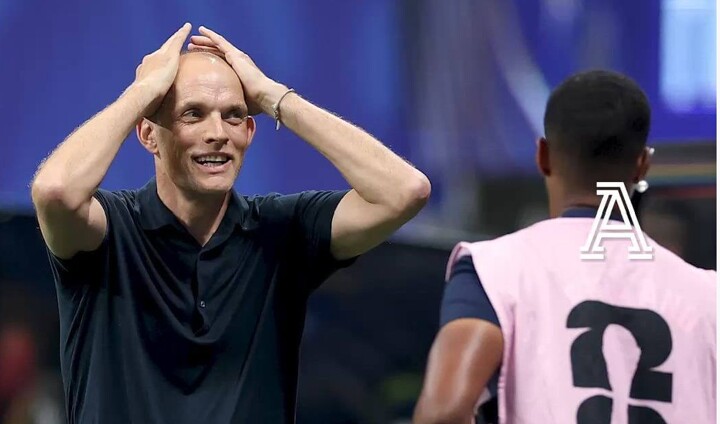
The final match for England in 2026 seemed destined to end only one way: desperately defending in front of their own box, holding onto a slim lead, and running down the clock against one of the world's top opponents.
For the past few months, England has been trying to emerge from the shadow of their match against Argentina. They wanted to prove that despite the scars left by the loss to Atalanta, they were still catching up to the world's strongest teams. So the course of this game was both fitting and almost fated: after an hour of brilliant play under Tuchel, the match reverted to the familiar defensive mode, with the same tense atmosphere and the re-introduction of Dan Burn.
But one thing was different: this time, they held on for the win.
Everyone who witnessed the last thirty minutes would have thought of the World Cup. England, playing with ten men, defended with all their might, reminiscent of the desperate defense against Mexico at the Estadio Azteca, only to finally crumble against Argentina in the semi-finals. As Spain constantly pressed, trying to equalize and snatch England's top spot in the Nations League group, it was easy to draw the familiar conclusion: England retreated again, punished again, history repeating itself four months later, just like the loss to Argentina.
This is how international football is; we always draw grand conclusions, both positive and negative, from fragmented details. As Tuchel said after the match, this game was either "Azteca 2.0" or a replica of the Atalanta loss, with no middle ground.
But in Madrid, at the crucial moment of the match, when Tuchel's coaching decisions were being tested, all the details were on England's side. This time, James Trafford was in goal instead of Jordan Pickford, making three crucial saves in the dying moments to secure the 3-2 scoreline. This time, Joshua Rice was in top physical condition, consistently holding off Spain's attacks and driving England forward. This time, Tuchel's substitutions worked, as he boldly replaced Harry Kane, Jude Bellingham, and Anthony Gordon, ensuring the team remained tough and disciplined. This meant that Dominic Calvert-Lewin, Spence, Myles Lewis-Kelly, and of course, Dan Burn, remained on the field.
When the final whistle blew, the entire England team's celebration far exceeded what would be expected for a regular Nations League group match. Kane and Bellingham linked arms as they usually do when celebrating, leading the players towards the 3,515 traveling away fans. But the significance of this match went far beyond a group game, even if it decided the group winner and secured a seeded spot for the quarter-finals in March.
For England and Tuchel, this was a major test. At the end of a tiring and inconsistent year, they had to prove they were still improving. They had to prove that the team had learned its lessons from the World Cup, and that the FA's decision in February to sign a new contract with Tuchel and trust him was the right one. As Tuchel repeatedly emphasized, they had to prove they were closing the gap with the world's top teams. An away match against Spain was the best possible testing ground.
Throughout the week, Tuchel's messages were very positive. He wanted to convince the players that they had the ability to defeat the World Cup and European Championship winners on their home turf. After training on Saturday, he affirmed the team's efforts and urged them to bring all their fighting spirit and form to Madrid. The players were infected by Tuchel's confidence and believed they could win. In Tuchel's words on Saturday evening, they were ready to "make the seemingly impossible a reality."
Even Tuchel himself had not anticipated such a stunning start.
Since taking over, Tuchel had always hoped to replicate the high-intensity tempo of the Premier League. However, in actual matches, this system often did not function smoothly. In the World Cup, England truly performed only in the second halves against Croatia and Panama. After the matches, Tuchel had been puzzled as to why the players found it difficult to translate their training level onto the pitch, and the team's operation always seemed to get stuck.
But in Spain, everything was different. In the first ten minutes, specifically the first eight minutes, this England team played football like never before: a high defensive line, high pressing, and quick attacks forward upon winning possession. Bellingham and Gordon consecutively had excellent chances, Joshua Rice pressed to suppress Martín Zubimendi, and Kane's shot grazed the post and went wide. They should have had a three-goal lead within ten minutes.
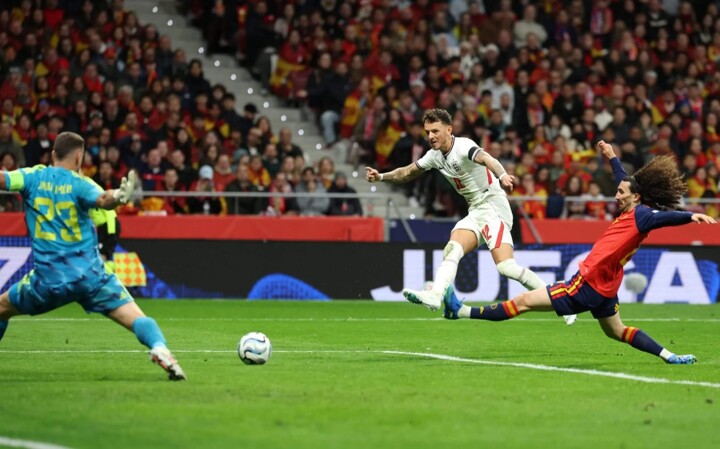
England failed to capitalize on these opportunities, but this did not affect the outcome, as they still took a 3-0 lead. First, Elliot Anderson delivered a through ball, and Kane won and converted a penalty; then, Joshua Rice delivered a corner, and Ezri Konsa headed in. The most spectacular goal came from a seamless team build-up from the back: Kane carried the ball forward, passed it to Bellingham, who calmly delivered a through ball, and Ben White made a late run to tap it in. This goal required perfect timing, teamwork, and trust, a combination only top teams can produce.
In modern international football, such goals are typically Spain's hallmark. This was England's most beautiful team goal in a generation.
Of course, the situation took a sharp turn after Anderson received a red card, and Mikel Oyarzabal converted a penalty, forcing England to retreat completely. But these thirty minutes of desperate defense should not overshadow the brilliance that preceded them. And because they held on for the win, this defensive period will not overshadow the team's highlights.
This hour was undoubtedly the best sustained performance by the team during Tuchel's tenure with England. This was not the World Cup, but the opponent was the World Cup champion, playing away, and the outcome of the match affected rankings. Tuchel had considered this match a "final" before kick-off precisely for this reason—to test England's performance under high pressure on a stage in November that most closely resembled a major tournament environment.
This time, Tuchel got what he wanted. High-intensity pressing in the opening stages, creating chances through high turnovers, efficient scoring from set pieces and counter-attacks, and calm and precise build-up from the back, relying on a solid new goalkeeper's distribution. This England team delivered a high-quality performance against an opponent widely considered the best in the world.
These aspects are more important than stubbornly defending to secure the victory. This proves that Tuchel is delivering on his promise and achieving the goal for which he was hired: closing the gap with top teams.
If they can maintain this momentum into 2027 and win the Nations League in June, Tuchel's second chapter as a coach might be even more exciting than his first.