


According to The Athletic, this expanded FIFA World Cup has averaged 3 goals per game, significantly higher than expected goals.
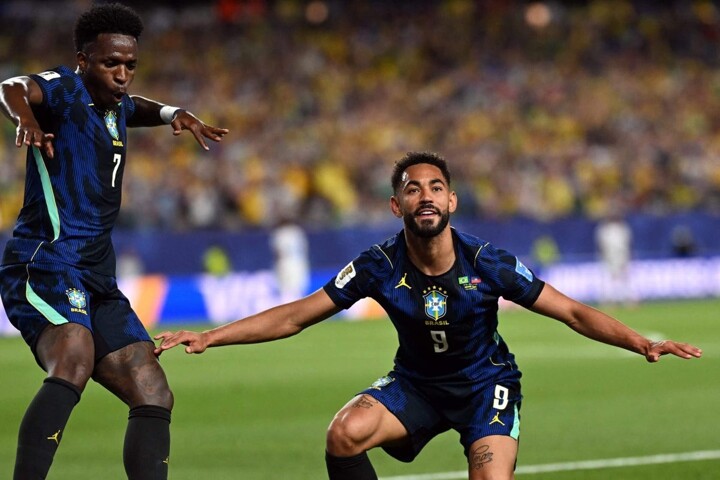
There's a simple metric to judge the quality of a major international tournament.
Generally, more goals mean more entertainment, and the opening stages of this expanded FIFA World Cup have seen more goals than usual.
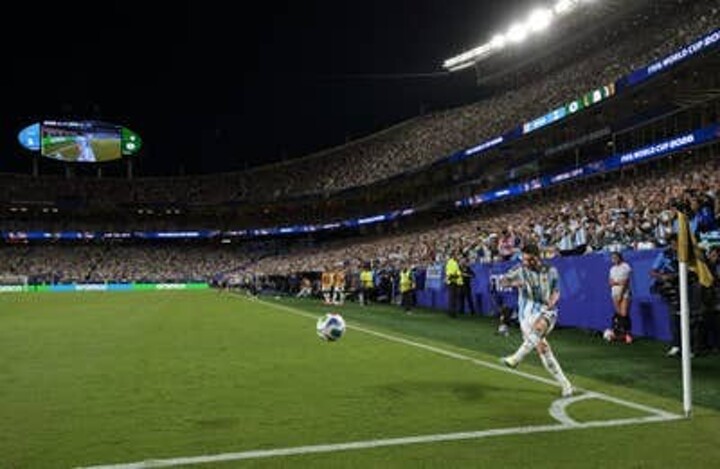
Currently averaging nearly 3 goals per game, it's the highest level since the 1958 FIFA World Cup. While the tournament is far from over, it's worth analyzing why it started so brightly.
This raises a key question: goals are football's hard currency, but are we getting a somewhat "inflated" return? To answer this, we turn to expected goals.
For those unfamiliar with this metric, expected goals measures the quality of each chance before a shot, considering contextual factors including shot angle, distance, and body part used.
Statistical models incorporate many variables, with values ranging from 0 to 0.99, where 0 represents no chance of scoring and 0.99 represents an almost certain goal.
By aggregating all chances so far, we can calculate how many goals should theoretically have occurred based on chance quality. Comparing this to actual goals tells us whether we've seen an over-performance.
Currently, the total expected goals for this tournament is 90, while actual goals scored reached 109, meaning actual goals exceed the expected tally by 19.
Comparing goals and expected goals with such a small sample of matches is not ideal. Even a full season of domestic club data can show volatility for some teams.
Therefore, these findings should be viewed with caution, but the most direct conclusion is that this tournament's goal total has exceeded expectations to an unprecedented degree.
Considering world-class finishers like Messi, Mbappé, and Kane, does this difference stem from elite finishing ability? Perhaps. Is it due to poor goalkeeping? Also possible. Even after excluding own goals, it's difficult to pinpoint the exact cause.
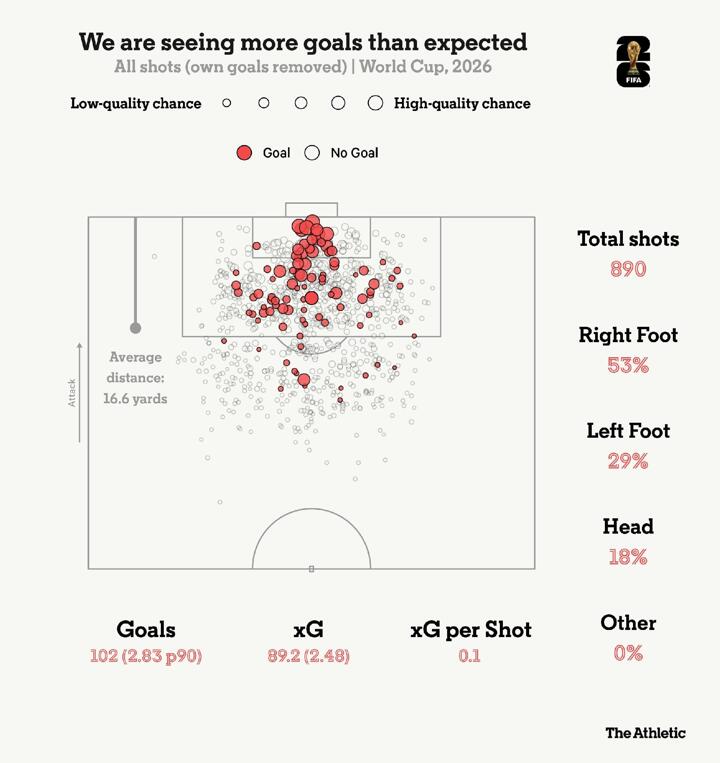
One characteristic of the FIFA World Cup is that it brings together national teams with significant strength disparities. When observing such a high conversion rate, quality-related factors may play a role.
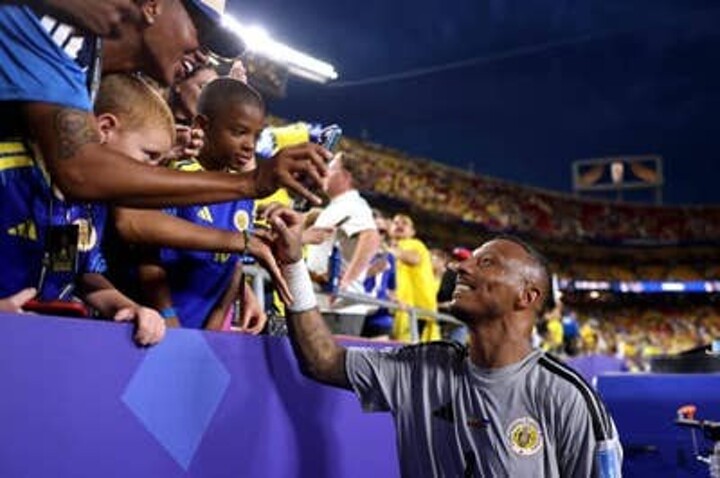
In the first round, Germany scored 7 goals against Curaçao, with several league champions and Champions League winners in their squad. In contrast, Curaçao goalkeeper Room plays for Miami FC in the second-tier US soccer league.
However, this over-performance cannot be attributed to an unusually high volume of long-range goals. Shots from outside the box account for 37% in this tournament, the same as in 2022 and lower than in 2018.
One hypothesis is that high-quality headed finishes have had an impact. So far in the group stage, there have been 15 headed goals. Since headers are first-time shots with the head, they typically have lower expected goal values in statistical models.
However, headed goals account for 17% of total goals in this tournament, nearly identical to 16% in 2022 and 19% in 2018.
Another factor is this FIFA World Cup's official match ball, the Adidas Trionda.
The Athletic discussed changes in the physical properties of major tournament balls during Euro 2024, and former England goalkeeper Joe Hart believes this may have influenced certain shots.
Hart stated in his BBC analysis: "I genuinely feel that the ball is traveling faster towards the goalkeeper than the goalkeeper perceives it coming off the boot."
He means that these subtle differences in flight trajectory might affect goalkeepers' split-second reactions, disrupting their usually precise hand-eye coordination.
Messi's first goal against Algeria was cited as an example. Hart also believes Pickford could have done better against Baturina's straight shot in England's opening match against Croatia.
Another example is Mbappé's long-range goal against Senegal. The quality of that shot is undeniable, but replays show that Édouard Mendy was actually close enough to make a save but couldn't adjust his body in time.
Hart said: "When the ball leaves the foot, it's certainly a good shot, but Mendy is a Champions League-winning goalkeeper. He just didn't get his hands up at the right time. I've noticed this in more and more high balls."
Whatever the reason for this over-performance in front of goal, this tournament has witnessed something unprecedented.
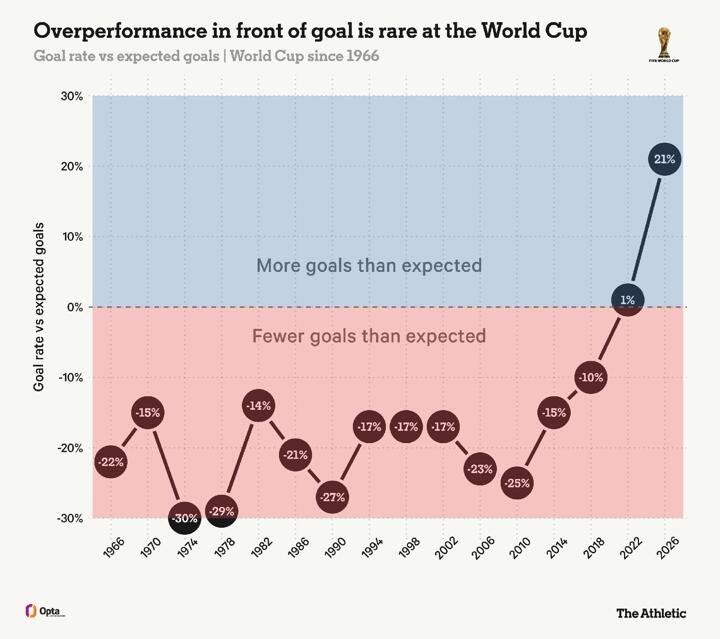
Adjusted for the number of matches in previous tournaments, the extent to which goals have exceeded expected goals in this tournament is unprecedented, with actual goals 21% higher than expected, significantly outpacing any other tournament.
A clear caveat is that this tournament is not yet halfway through. This means the ratio will almost certainly decrease once the knockout stage begins.
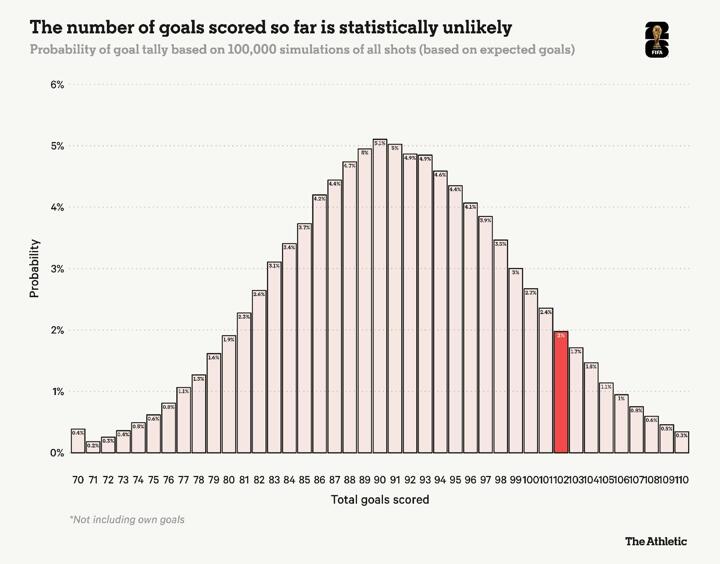
Nevertheless, it's worth emphasizing how rare the current outcome is.
If we run 100,000 simulations based on the expected goal value of each of the 889 shots in this tournament, the probability of reaching the current total of 102 goals is only 2%, after excluding own goals. According to the model, the probability of this tournament reaching 80 goals—10 fewer than expected—is virtually the same as reaching 102 goals, both at approximately 1.9%.
Fortunately, the variance is on the entertaining side, allowing us to witness more goals this summer of football.
If the co-hosts the United States want to promote football—or soccer—providing more entertaining matches for spectators in this summer's showcase certainly helps.
Yes, it's too early to assume this goal-scoring efficiency will persist over the coming weeks. But in international tournament football, where statistical patterns are inherently difficult to capture due to the limited number of matches, we can at least enjoy this unusual phenomenon for now.